Snooker looks complicated the first time you watch it: a huge green table, balls of seven different colours and a scoreboard that seems to change by strange amounts. The truth is that the game is built on one simple idea — pot a red, then pot a colour, and repeat — and everything else is detail. This guide walks you through that idea step by step so that you can follow a frame, play one with friends, or try it right now on our free online snooker table.
What snooker is
Snooker is a cue sport played by two people (or two teams) on a large rectangular table with six pockets. Players take turns to strike a white cue ball with a cue so that it hits other balls, aiming to knock them into the pockets. Every ball you pot — pocket — earns points, and the player or side with the most points when the balls run out wins the frame. A match is usually decided over several frames, and professional finals can last for dozens of them.
The name is also a verb. To be “snookered” means the cue ball is stuck behind another ball so that you cannot hit the ball you are supposed to play in a straight line. Much of the strategy in snooker is about leaving your opponent in exactly that kind of trouble. The sport is widely reported to have been invented by British army officers in India in the 1870s.
The equipment you need
The table. A full-size table is 12 feet by 6 feet (about 3.6 m by 1.8 m), covered with a fine green woollen cloth called baize. It has six pockets: one in each corner and one in the middle of each long side. Smaller tables are common in clubs and homes, and the rules are the same.
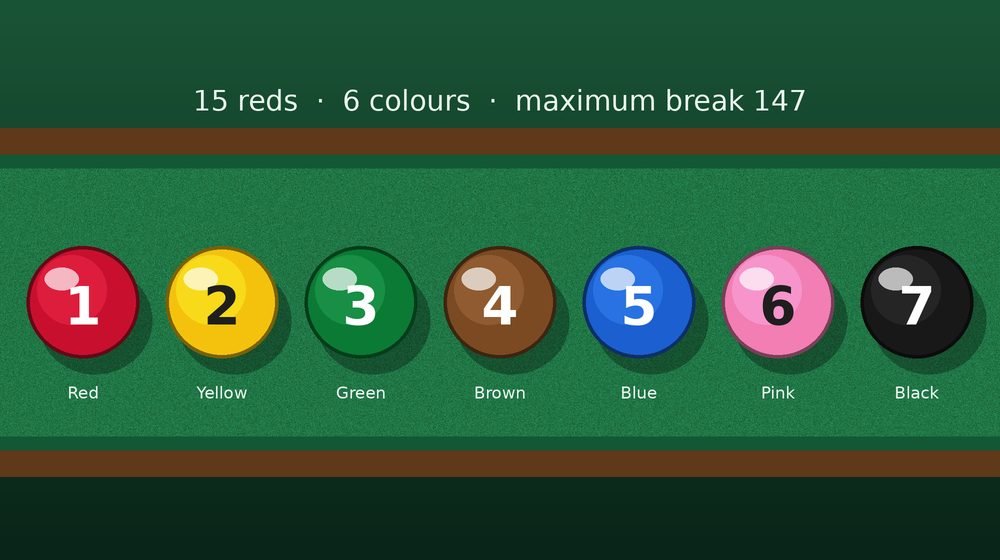
The balls. There are 22 balls in total, each about 52.5 mm across: one white cue ball, fifteen reds worth one point each, and six “colours” — yellow (2), green (3), brown (4), blue (5), pink (6) and black (7). Our guide to snooker ball points explains the values in more detail.
The cue and accessories. The cue is a long, tapered stick with a small leather tip, which players chalk to stop it slipping. A rest — a stick with a cross-shaped head — helps you reach distant balls.
How the balls are set up
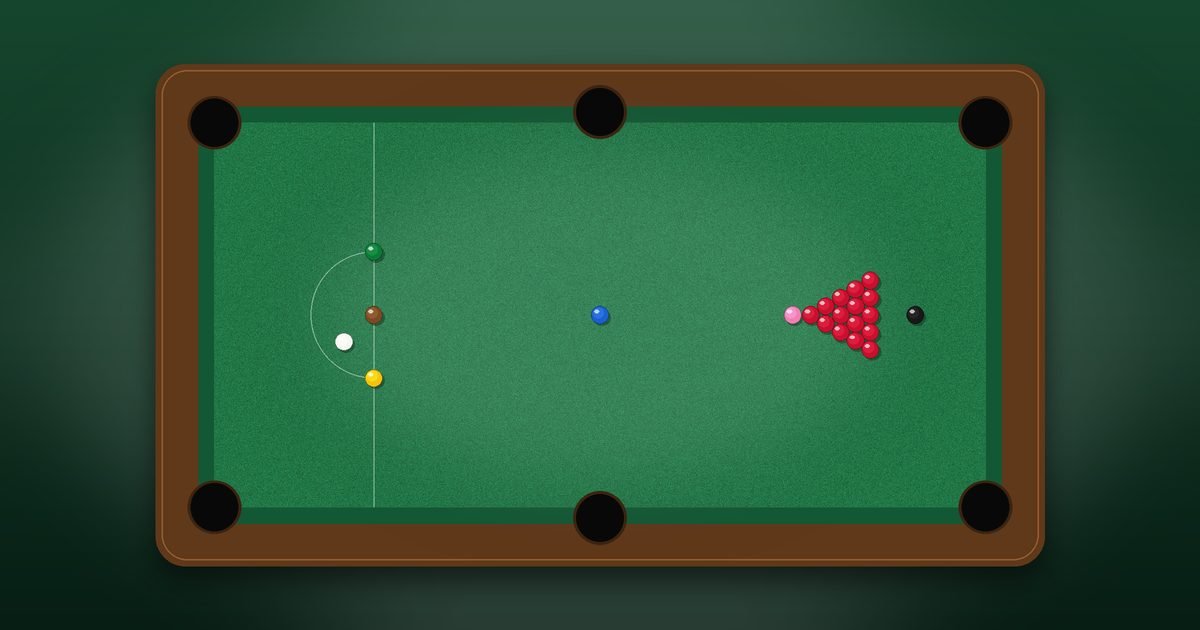
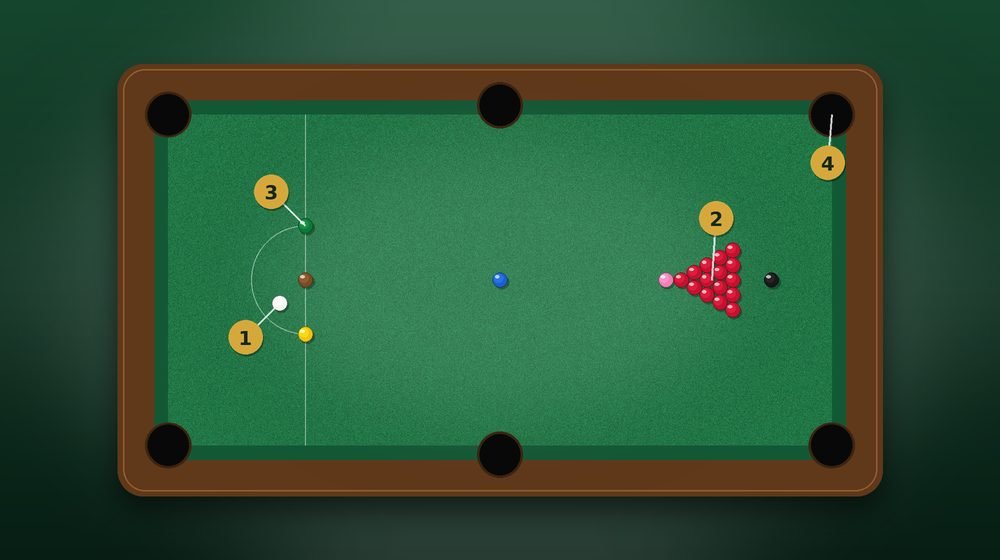
The table has three important markings. The baulk line runs across the table about a fifth of the way along from one end. The D is a semicircle drawn on the baulk side of that line. Several small spots mark where each colour belongs.
- The yellow, green and brown sit on the baulk line: yellow on one end of the D, green on the other, brown in the middle.
- The blue sits on the exact centre of the table.
- The pink sits halfway between the blue and the far cushion.
- The black sits near the far cushion, on the line through the centre spots.
- The fifteen reds are racked in a tight triangle with the point towards the pink, as close to the pink as possible without touching it.
The cue ball starts anywhere inside the D.
How a frame is played
The break-off
The players decide who starts by tossing a coin. The first player hits the cue ball from the D and tries to send it up the table, usually touching the back of the reds and returning to baulk. The aim is to avoid leaving an easy chance, not to pot.
Phase one: red, colour, red, colour
The player at the table must first hit a red. If they pot one, they score a point and must then nominate and pot any colour. If they pot that too, they score its value, the colour is lifted out of the pocket and put back on its spot, and they must go for another red. This continues for as long as they keep potting. A run of scoring shots in one visit is called a break.
When a shot fails to pot the right ball — or when the player makes a foul — the turn passes to the opponent, who plays from wherever the balls have come to rest.
Phase two: the colours in order
Once the last red has gone and one final colour has been potted after it, the colours are no longer put back. Players must then pot them in ascending order of value: yellow, green, brown, blue, pink and finally black.
Taking a shot: stance, bridge and cue action
Good technique matters more than power. Beginners can concentrate on four things.
- Stance. Stand with your feet roughly shoulder-width apart, with the cue directly underneath your chin so that you look straight down the line of the shot. Bend from the hips and keep your head still.
- Bridge. Rest your front hand flat on the cloth and raise your thumb to form a groove against the first finger. The cue slides through that groove like a rail, around 15–20 cm in front of the ball.
- Grip. Hold the cue lightly at the butt with your back hand, thumb and first two fingers doing most of the work. A tight grip causes the cue to wobble.
- Delivery. Draw the cue back slowly in a straight line, pause, then accelerate smoothly through the ball and keep the cue still for a moment after contact. This follow-through is a habit that separates steady players from erratic ones.
More detailed drills are in our article on practical tips to improve your aim and cue-ball control.
Fouls in one minute
A foul gives your opponent points — at least four, and up to seven. The most common fouls are potting the white ball (an “in-off”), hitting the wrong ball first, failing to hit any ball, and knocking a ball off the table. The full list, with penalty values, is in Snooker Rules Explained.
Winning a frame and a match
A frame ends when the final black is potted, or earlier when a player concedes because the opponent is too far ahead to catch. If the scores are level after the black, it goes back on its spot and the next pot or foul decides the frame. In a match, the winner is the first to reach a set number of frames — “best of nine” means the first to win five. The maximum break is 147.
Etiquette and good habits
- Stay still and silent when your opponent is shooting.
- Be honest about touching a ball. If you disturb one, admit it; snooker has a strong tradition of self-reporting fouls.
Where to go from here
You do not need a club membership to start learning. Begin by potting reds and colours alternately in practice mode on our online snooker table, where the game keeps score and flags fouls so that you learn the rules by playing. Then read how snooker differs from pool if you have played the latter, and come back to the ball values guide whenever you need a refresher. With a clear idea of the sequence — red, colour, red, colour, then the colours in order — you already understand the heart of the game.