Snooker has a rich vocabulary of its own, from everyday words with special meanings to terms handed down from billiards. If you have ever watched a match and wondered what a commentator meant by “plant”, “kiss” or “on a break”, this glossary is for you. The terms below are grouped by theme and explained in plain English, with links to our longer guides where you can learn more. Bookmark it and return whenever you meet an unfamiliar word.
Table and equipment
- Baize
- The fine woollen cloth that covers the table. Often called simply “the cloth”.
- Baulk
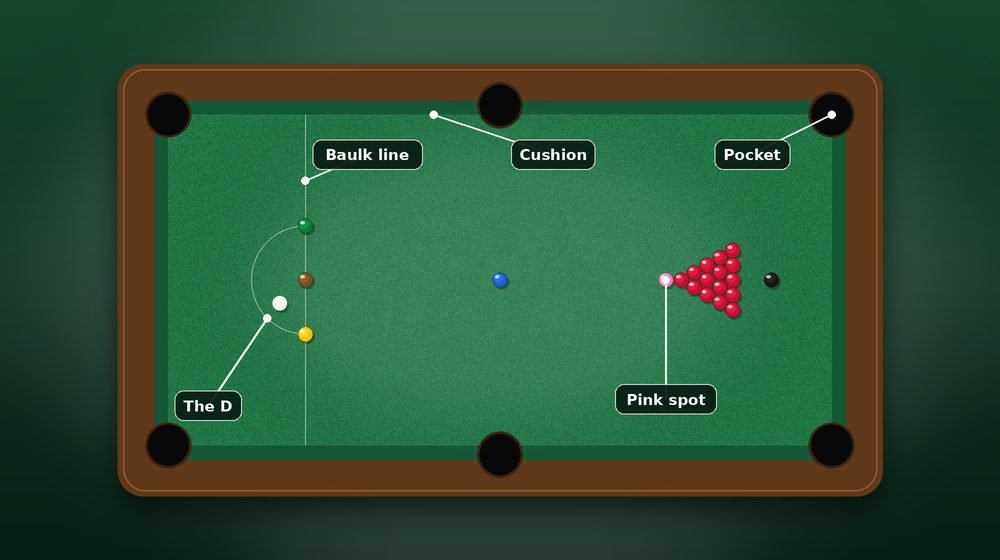
- The area at the starting end of the table, between the baulk line and the bottom cushion. Also spelled “balk” in some places.
- Baulk line
- The line drawn across the table that separates baulk from the rest of the table. The brown, green and yellow balls sit on it.
- Butt
- The thick, rear section of the cue, held by the back hand.
- Cushion
- The rubber strip, covered in cloth, that forms the edge of the playing surface.
- D
- The semicircle on the baulk side of the baulk line. The cue ball is placed inside it at the start of a frame.
- Ferrule
- The short ring between the tip and the shaft of the cue.
- Jaws
- The curved edges of the cushions around a pocket’s opening. Balls that strike them may bounce out.
- Nap
- The direction in which the fibres of the cloth lie. It affects how balls roll over long distances.
- Rest
- A long stick with a cross-shaped head, used to support the cue when the ball is out of reach. The spider and swan are special versions. See our bridge and rest guide.
- Spot
- A small mark on the table showing where a coloured ball belongs.
- Tip
- The small piece of leather on the end of the cue that touches the ball.
Balls and scoring
- Ball on
- The ball or balls a player is permitted to hit first with the cue ball. With reds on the table, any red is on. After a red, any colour is on.
- Break
- A run of scoring shots made in one visit to the table. See our break-building guide.
- Century
- A break of 100 or more points.
- Colours
- The six non-red object balls: yellow, green, brown, blue, pink and black.
- Cue ball
- The white ball struck by the cue.
- Frame
- A single game of snooker, from the break-off until one player wins or concedes.
- Free ball
- A ball that a player may nominate as a ball on after an opponent’s foul has left them snookered.
- Maximum (147)
- The highest possible break in an ordinary frame: fifteen reds with fifteen blacks, then all six colours in order.
- Pack
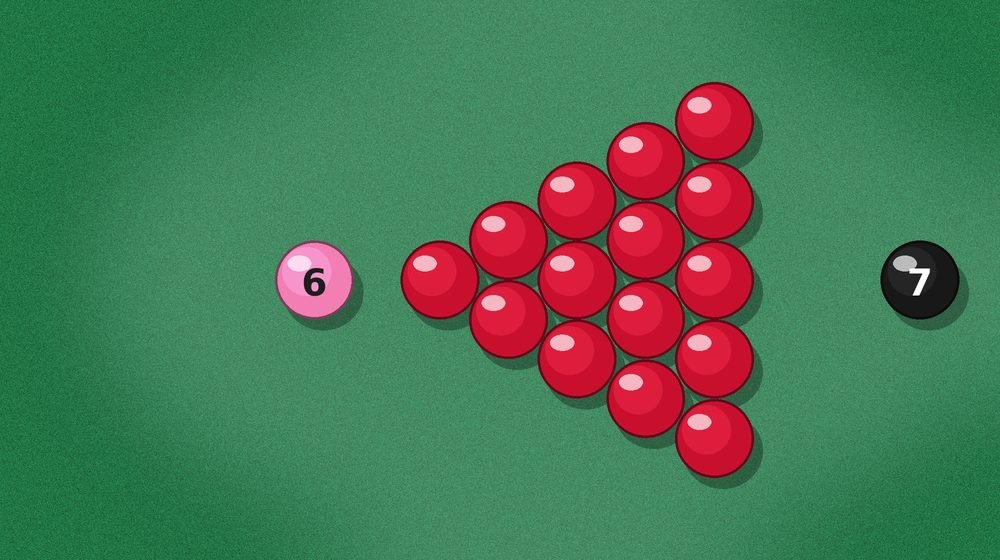
- The triangle of fifteen reds at the start of a frame.
- Points on the table
- The total remaining score available. See our guide to snooker ball points.
- Respotted black
- A tie-break played with a single black ball when a frame ends level.
Shots and technique
- Bridge
- The hand shape that supports the front of the cue, or the act of forming it.
- Cannon
- A shot where the cue ball hits two object balls in succession. It is a term borrowed from billiards.
- Cut
- A shot where the cue ball hits the side of the object ball, sending it at an angle rather than straight ahead.
- Double
- A shot where an object ball is sent against a cushion and then into a pocket on the opposite side.
- Fluke
- A successful shot that happens by luck rather than intention.
- Follow-through
- The continued forward movement of the cue after the tip has struck the ball.
- Kick
- A shot where the cue ball hits a cushion before the ball on, often to escape a snooker.
- Miscue
- A shot in which the tip slips off the cue ball, usually causing a weak or misdirected result.
- Plant
- A shot in which one object ball, when struck, sends another into a pocket. The balls are lined up so that the first transfers its direction to the second.
- Pot
- To knock an object ball into a pocket. Americans say “sink” or “make”.
- Screw, stun, follow
- The three basic cue-ball actions, described below.
- Set
- A position where two balls touch or nearly touch, allowing a plant.
- Swerve
- A curved path produced by hitting the cue ball with the cue raised and with side spin.
Spin and cue-ball control
- Backspin / screw
- Spin caused by hitting below centre, making the cue ball travel backwards after contact.
- English (side)
- Spin applied by hitting the cue ball to the left or right of centre. In British snooker it is simply called “side”.
- Positional play
- Controlling where the cue ball stops, so that the next shot is easy.
- Stun
- A shot with little or no top or backspin at contact, causing the cue ball to stop or move off at a right angle.
- Topspin / follow
- Spin caused by hitting above centre, making the cue ball roll forward after contact.
- Weight of shot
- The pace at which the ball is struck.
The three basic actions are explained step by step in our cue-ball spin guide.
Tactics and positions
- Behind the ball
- A position where the cue ball cannot see the ball on because another ball blocks it.
- Clearance
- Potting all the remaining balls in one visit to win a frame.
- Containing shot
- A safety shot that keeps the balls tied up in one area of the table.
- Escape
- Successfully hitting a ball on after being snookered.
- Open table
- A situation in which the reds are spread out and there are many scoring chances.
- Safety
- A shot played to leave the opponent without a pot. See our guide to safety play.
- Snooker
- A position where a ball that is not on blocks the direct path to every ball that is on. See snookers and escapes.
- Snookers required
- The situation in which a player needs more points than remain on the table, so can win only if the opponent concedes fouls.
- Splitting the pack
- Playing a shot that separates the reds from each other and opens the table.
Fouls and rules
- Foul
- A breach of the rules, penalised by at least four points to the opponent. See Snooker Rules Explained.
- Foul and a miss
- A referee’s call when a player fails to make a good attempt to hit the ball on. The opponent may ask for the shot to be replayed.
- In-off
- The cue ball going into a pocket. It is a foul.
- Push shot
- A foul where the cue stays in contact with the cue ball too long, pushing it rather than striking it.
- Respot
- Putting a ball back on its spot after it has been potted or forced off the table.
- Touching ball
- A situation where the cue ball is in contact with the ball on at the start of a shot.
Match and tournament terms
- Best of
- The format of a match. “Best of nine frames” means the first to win five frames wins. See our guide to frames and match formats.
- Concede
- To accept defeat in a frame before it is finished.
- Handicap
- A system that gives weaker players a starting advantage.
- Ranking points
- Points awarded for results in professional tournaments, used to set the world rankings.
- Session
- A block of frames played in one sitting, often in the afternoon or evening of a match day.
- Triple Crown
- The three most prestigious professional events: the World Championship, the UK Championship and the Masters.
Commentary and slang
- Bounce
- When a ball hits the jaws of a pocket and does not drop in.
- Kiss
- A slight contact between two balls, often unintended, that changes their paths.
- Rattling the jaws
- A ball that strikes both sides of a pocket but stays out, or just drops in.
- Screw back
- A shot where the cue ball returns down the table after potting a ball.
- Shot to nothing
- An attempt to pot a ball that leaves the opponent no chance if it fails, so there is little risk.
- The black ball finish
- A frame that comes down to the last ball.
- Up the table, down the table
- Directions along the length of the table. “Up” is toward the top cushion, away from baulk.
If you want to see these terms in action, the quickest way is to play. Open our free online table, play a few frames, and use this glossary as a reference. For a complete walk-through of the basics, start with our beginner’s guide.