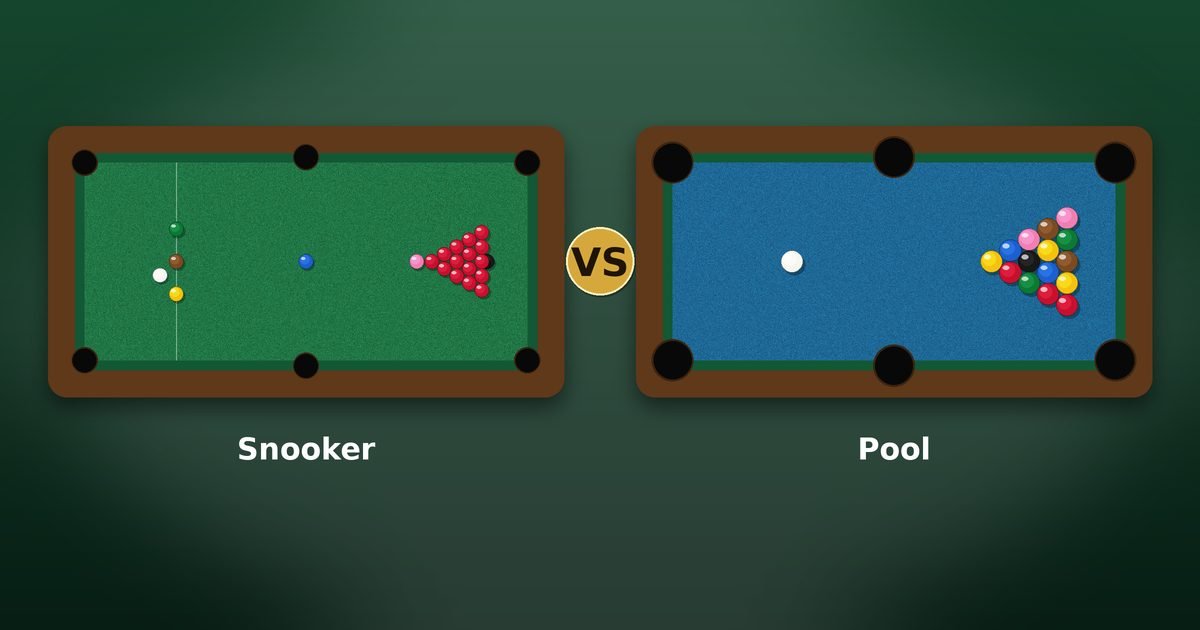
Snooker and pool are close cousins: both use a cloth-covered table, a cue and balls that are knocked into pockets. Yet they play very differently. Whether you are curious about trying snooker after a few games of pool, or just want to know why snooker looks so unforgiving, this comparison covers the tables, balls, pockets, cues, rules and tactics that set the two games apart.
Quick comparison
| Feature | Snooker | Pool (US 8-ball / 9-ball) |
|---|---|---|
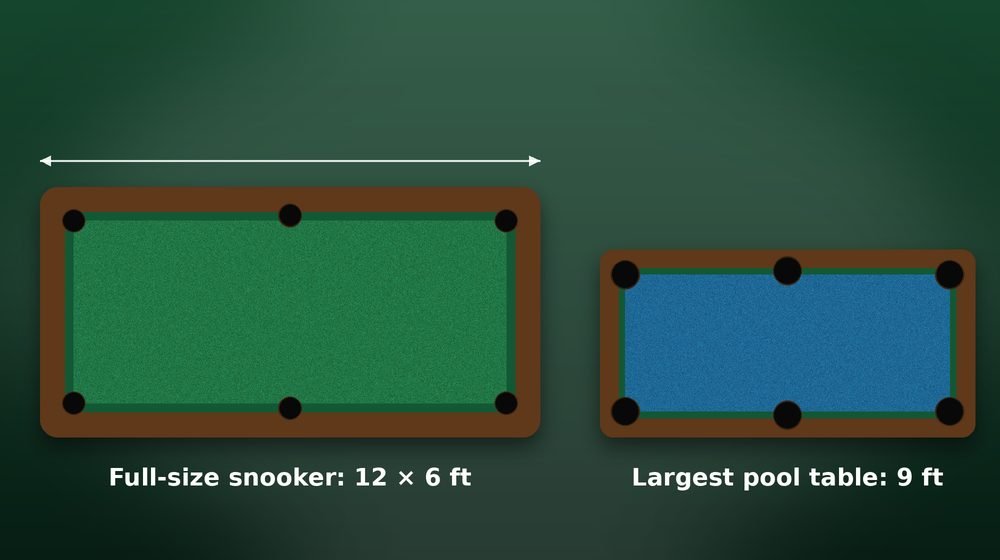
| Table size | 12 × 6 ft full size (smaller versions exist) | 7 ft, 8 ft or 9 ft |
| Ball diameter | About 52.5 mm | About 57.2 mm |
| Number of balls | 22 (15 reds, 6 colours, cue ball) | 16 for 8-ball; 10 for 9-ball |
| Pockets | Narrow, rounded jaws | Wider, often angled mouths |
| Cloth | Napped woollen baize | Smooth worsted cloth |
| Cue tip | Typically 9–10 mm | Typically 12–13 mm |
| How you score | Points for each ball potted, in sequence | Win a rack by pocketing your group or the 9-ball |
| Match unit | Frames | Racks |
Tables and cloth
The most obvious difference is size. A full-size snooker table is 12 feet by 6 feet overall, which makes it significantly larger than a pool table; even the biggest tournament pool table is 9 feet. More surface means longer shots, greater demands on accuracy and more room to manoeuvre the cue ball.
The surface also differs. Snooker tables use a woollen baize with a nap — tiny fibres lying in one direction. The nap affects how balls roll: over a long distance a ball can drift slightly with or against it. Pool tables use a tighter worsted cloth without a noticeable nap and are normally faster and more uniform. The cushions in snooker are firmer and the table markings include a baulk line and a D, which have no counterpart in pool.
Balls
Snooker balls are smaller than American pool balls, about 52.5 mm compared with roughly 57.2 mm (2¼ inches). They are plain in colour, with reds and six different colours, and there are no numbers. Pool balls in the American game are numbered and have a mix of solids and stripes. English pool, popular in British pubs, uses smaller 2-inch (50.8 mm) balls, usually red and yellow, with a black ball for the finish.
The number of balls on the table in snooker also affects the style of play: with 15 reds clustered together at the start, there are many possible pots but also many blockers. In pool, the 15 balls are racked in a triangle and are meant to be split on the break, so the table opens quickly.
Pockets
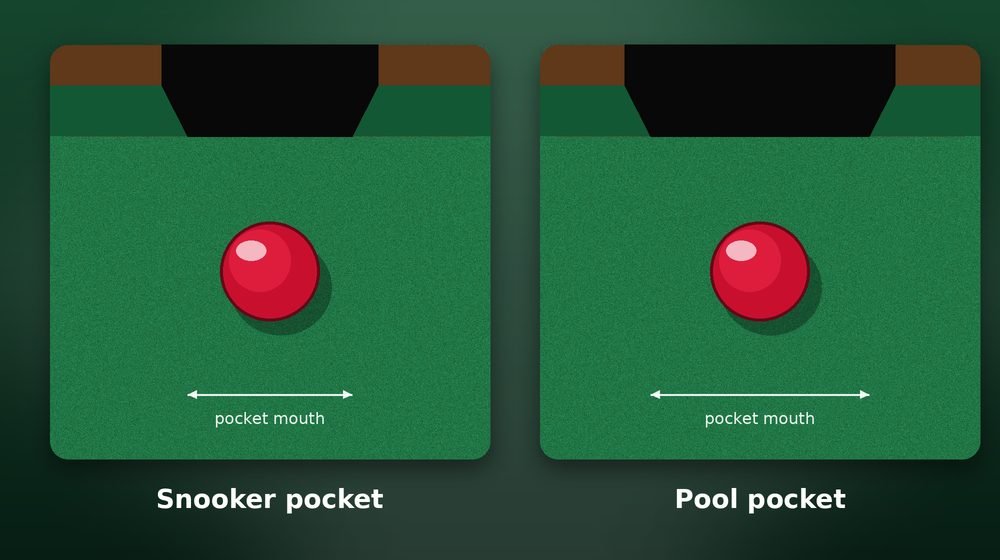
Snooker pockets are famously tight. The mouth of a corner pocket is well under two ball diameters wide, and the jaws are rounded, so a ball that arrives too fast or at the wrong angle will “rattle” and stay out. Pool pockets are comparatively generous, especially on bar tables, with wider mouths that allow balls to drop even when they are slightly off-centre. This is the main reason that potting in snooker is a much more exacting skill, and why a high break needs good technique and cue-ball control. Our online game recreates the jaw effect so that your pots behave in a similar way.
Cues and equipment
Snooker cues generally have a smaller tip diameter, which allows precise contact on the smaller balls. Pool cues tend to be shorter and their larger tips give a little more forgiveness. Other equipment is also different: snooker players often use a variety of rests — spider, cross, extended — to reach balls across the large table. Pool players use a mechanical bridge for the same reason, though less often.
Rules and scoring
The two games have very different goals. In snooker you accumulate points by potting balls in a strict sequence: a red, then a colour, repeated, and then the colours in order from yellow to black. The total points scored decide each frame. Our ball values guide and rules explainer go through this in detail.
In American 8-ball, one player takes solids (1–7) and the other stripes (9–15); each tries to clear their group and then pot the 8-ball. In 9-ball, players must hit the lowest-numbered ball first, and the player who legally pockets the 9-ball wins the rack. There is no points tally — you either win the rack or lose it. Fouls also differ: in snooker a foul gives the opponent at least four points, whereas in most forms of pool a foul gives the opponent “ball in hand” anywhere on the table.
Tactics and skills
Snooker is a game of safety and long breaks. Players frequently leave the cue ball tucked behind another ball or hard against a cushion to create a “snooker”, forcing the opponent to risk a foul. A good break takes planning many shots ahead. Pool is more oriented towards pattern play: you plan the order in which you pocket your balls and manage the break, with ball-in-hand after a foul providing a recovery option. Accurate long-distance potting is a bigger part of snooker, while position and rack management dominate pool.
Which should you play?
If you enjoy a social, fast-moving game with generous pockets, pool is easy to pick up. If you like technical challenge, strategic battles and the satisfaction of building a break, snooker is rewarding. Many players enjoy both, and skills transfer more than you might expect: a straight cue action, accurate aim and cue-ball control help in either sport.
The easiest way to try snooker is to play a few frames of our free online game. It runs in any modern browser on desktop or mobile, and its practice mode lets you learn the red–colour sequence alone. When you want to improve, the beginner’s guide and the ten practical tips will help you get started.