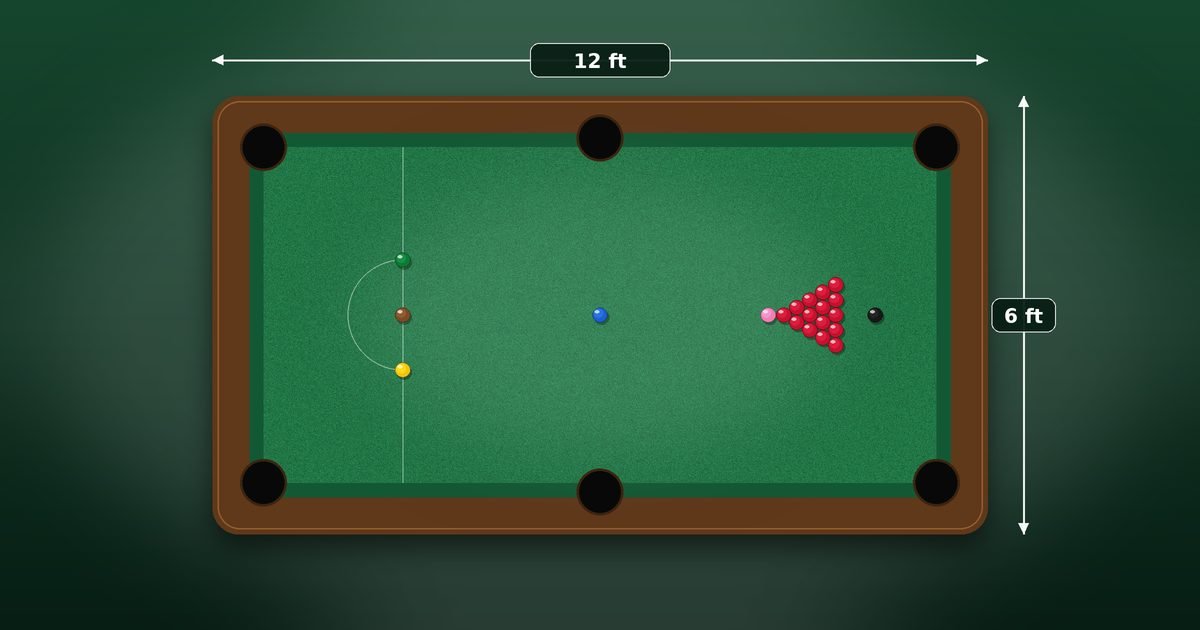
A snooker table looks simple from a distance: a big green rectangle with six pockets. Up close it is one of the most precisely specified playing surfaces in sport. The size of the bed, the height of the cushions, the shape of the pocket jaws and the position of every spot are all fixed by the rules, and each one affects how the game plays. This guide explains the dimensions of a full-size table, what the markings mean, where each ball goes, and what changes on smaller tables.
Full-size table dimensions
A full-size snooker table is described as 12 feet by 6 feet, which is the outside measurement of the frame. The actual playing area, measured between the cushion noses, is slightly smaller: about 11 feet 8½ inches by 5 feet 10 inches (roughly 3569 mm by 1778 mm). The rules allow a small tolerance on those figures, but in practice tables are built very close to them.
The table is exactly twice as long as it is wide. That simple ratio is part of why the geometry of the game feels so tidy: the centre of the table sits on the middle of the long axis, and the layout of the colours is measured from the ends along that centre line.
The playing surface is made of slate, usually three thick slabs joined and levelled to act as one flat bed, topped with a cloth. The edge of the playing area is formed by six cushions: one at each end and two along each long side, broken up by the pockets.
Baulk line, D and spots
Three markings divide the table into the areas used for the opening shot and for placing the colours.
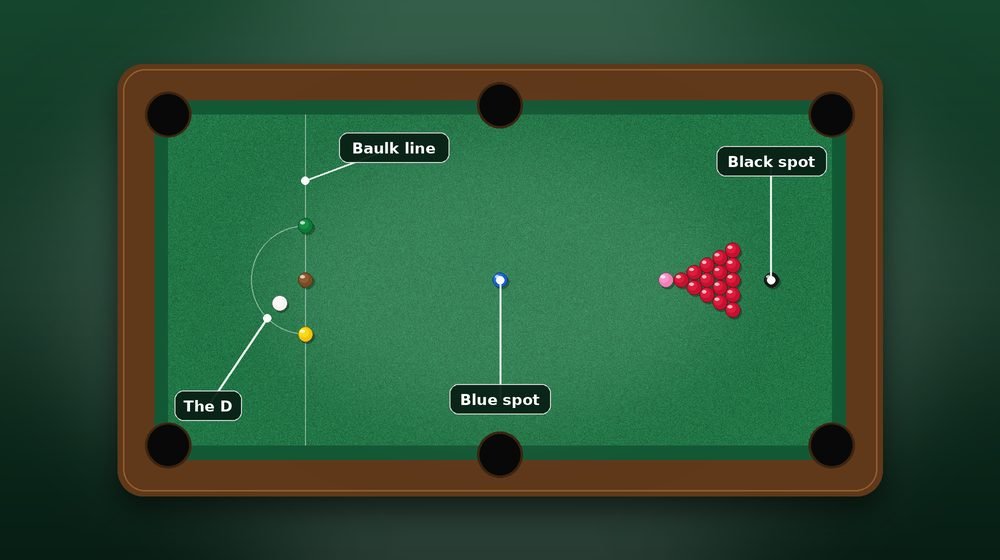
- The baulk line is a straight line drawn across the table, 29 inches (737 mm) from the bottom cushion, which is also called the baulk cushion. The area between the baulk line and the baulk cushion is known as baulk.
- The D is a semicircle drawn on the baulk side of the line. Its radius is 11½ inches (292 mm), and its straight edge is the baulk line itself. The cue ball is played from inside the D at the start of a frame and after certain fouls or when it has been pocketed.
- The spots are small marks on the cloth that show where each coloured ball is replaced after being potted. There is one for each of the six colours. The pink spot is also called the pyramid spot, because the apex of the red triangle is measured from it.
The part of the table above the baulk line, which contains the remaining balls, is simply called the top end or the top of the table. The cushion at that end is the top cushion.
Where every ball is placed
At the start of a frame the balls are arranged in a fixed pattern. You can check any table against this list.
| Ball | Value | Position |
|---|---|---|
| Yellow | 2 | On the baulk line, at the right-hand corner of the D as you face the top cushion |
| Green | 3 | On the baulk line, at the left-hand corner of the D |
| Brown | 4 | On the baulk line, in the centre of the D |
| Blue | 5 | On the centre spot of the table, midway between the middle pockets |
| Pink | 6 | Halfway between the blue spot and the top cushion (the pyramid spot) |
| Black | 7 | On the black spot, 12¾ inches (324 mm) from the top cushion on the centre line |
| Reds | 1 each | Racked in a triangle of fifteen, apex towards the pink, base parallel to the top cushion |
The red triangle sits as close to the pink as possible without touching it. Racking is usually done with a plastic or wooden triangle, and the balls must touch one another, which keeps the opening break fair and consistent. If you want a refresher on what each colour is worth, see our guide to snooker ball points.
The order of the three baulk colours surprises many beginners. Standing at the baulk end and looking up the table, yellow is on the right of the D, brown is in the middle and green is on the left. A simple memory aid is “God Bless You, Boys”: green, brown, yellow, read from left to right.
Pockets and cushions
There are six pockets: four in the corners and two in the middle of the long sides. The pockets of a snooker table are notoriously tight. They are only a little wider than the ball, and the jaws, the cushion edges that guide a ball in, are rounded rather than angled. This is very different from many pool tables, where pockets are more generous. The corner pockets are slightly narrower than the middle pockets, but the middle pockets are cut so that balls entering at an angle can catch the jaws and rattle out.
The cushions themselves are strips of rubber covered in cloth. The cushion nose, the point where the ball makes contact, sits at a carefully specified height above the bed so that the ball rebounds cleanly without climbing the rubber. If the cushions become hard or dead with age, the speed of rebounds changes, which is why club tables are periodically re-rubbered.
It is also why the shape of the pocket jaws is so crucial. A ball that approaches the pocket with too much pace can bounce off the jaw and out again, an outcome snooker players call a rattle or a kick. A ball played with gentler speed has a better chance of dropping. For more on how pace affects pots, read our snooker tips on aim and cue-ball control.
Slate bed, cloth and height
The table bed is made from slate because it stays flat, does not warp as the weather changes, and gives an even roll. The slate is carefully levelled with shims and spirit levels so that a ball placed anywhere on the table will stay where it is put. A table that is not level will cause balls to drift, which makes accurate play almost impossible.
Over the slate lies the cloth, a fine woollen baize with a nap. The nap, the direction in which the fibres lie, runs from the baulk end to the top end. It has a small but real effect, particularly on slow shots along the length of the table. Balls can run a fraction differently with the nap than against it, and a very slow ball may drift slightly sideways, so experienced players learn how their own club’s cloth behaves. We cover cloth in more detail in our guide to table cloth and care.
The playing surface stands between about 33½ and 34¼ inches (roughly 851 to 870 mm) above the floor. Table height matters for comfort and for stance, particularly when you are learning to bend over the table. If you are putting a table in a home, the height is not adjustable, but the cue length and your stance can be.
Smaller table sizes
Few homes have space for a full-size table, so a range of smaller sizes is sold and used in clubs, pubs and houses. The most common are:
- 10 ft by 5 ft. A popular size that keeps the proportions of the full table but reduces the length of the long shots.
- 9 ft by 4 ft 6 in. Common in clubs and in homes with a large room.
- 8 ft by 4 ft and 6 ft by 3 ft. Often used for practice and for children, as the shorter distances are more manageable.
On smaller tables the same rules apply, but because the layout is scaled, the balls are closer together and potting long shots is easier. Some smaller tables use slightly smaller balls to keep the proportions right. Playing on a smaller table is a good way to build confidence, though many players find that moving back to a full-size table feels like learning a new game.
How much room do you need?
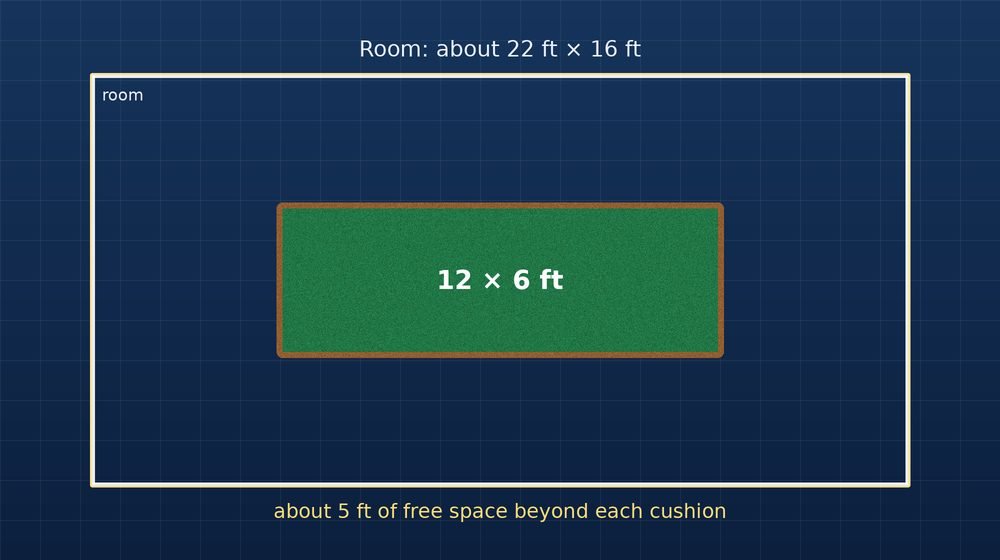
To play comfortably, you need space around the table to swing a full-length cue on every shot. That means a clear margin on all sides. As a rough guide, you want about five feet of free space beyond the cushion on each side of the table, so a full-size table needs a room of around 22 feet by 16 feet. A 10-foot table needs about 20 feet by 15 feet, and so on. Short cues and sidearms can help in tighter rooms, but a good player wants to hit the ball squarely from any position without hitting a wall.
Lighting is just as important. A table is normally lit by a long, shaded lamp that hangs over the middle at a controlled height, giving even, shadow-free light across the whole cloth. A dark corner or a glare on the cushion can make accurate aiming very hard.
Why the layout matters for play
The layout of the table is not arbitrary. Its dimensions have shaped how the game is played in several ways.
- The tight pockets and the narrow ball make potting harder, which rewards patient, accurate play.
- The 2:1 proportion means that, from baulk, the cue ball can travel the full length of the table and return, a shot you will use constantly in safety play and in the opening exchanges. Our guide to safety play explains how.
- The position of the black near the top cushion means that the pack of reds usually sits close to it, so that a player who breaks the pack open can often reach the black to continue a break.
- The baulk colours at the bottom of the table create a natural area where the cue ball ends up after many shots, and the D gives the incoming player a natural place to restart.
If you are new to the game and want to see the whole structure put together, our complete beginner’s guide walks through a full frame, and the comparison in snooker vs. pool shows how the tables differ.