Every ball on a snooker table carries a fixed number of points, and learning those values is the quickest way to understand how a frame is won. This guide explains what each ball is worth, where it sits on the table, how a break builds up, how foul points fit in, and how to work out how many points are left in a frame.
The ball values at a glance
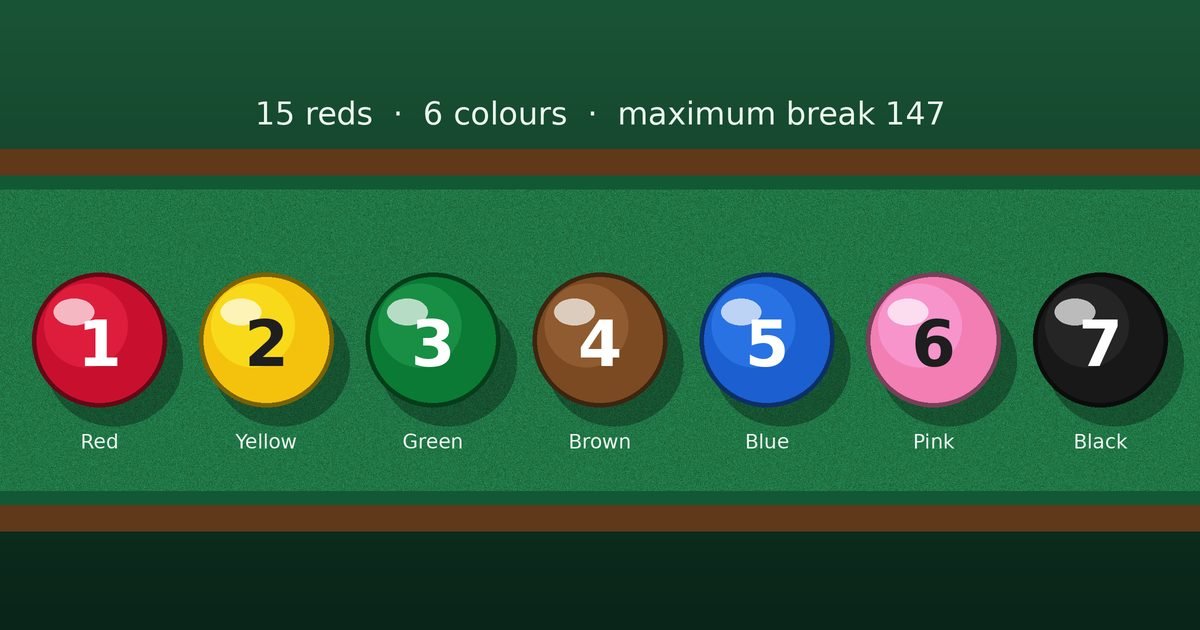
There are 21 object balls and one cue ball on the table at the start of a frame. The cue ball is white and has no value: it is the ball you strike. The fifteen reds are each worth one point, and the six colours are worth between two and seven points.
| Ball | Points | Quantity | Re-spotted while reds remain? |
|---|---|---|---|
| Red | 1 | 15 | No — stays in the pocket |
| Yellow | 2 | 1 | Yes |
| Green | 3 | 1 | Yes |
| Brown | 4 | 1 | Yes |
| Blue | 5 | 1 | Yes |
| Pink | 6 | 1 | Yes |
| Black | 7 | 1 | Yes |
The six colours add up to 27 points. That number turns out to be important when we look at the maximum break and at counting what remains on the table.
Where each ball is placed
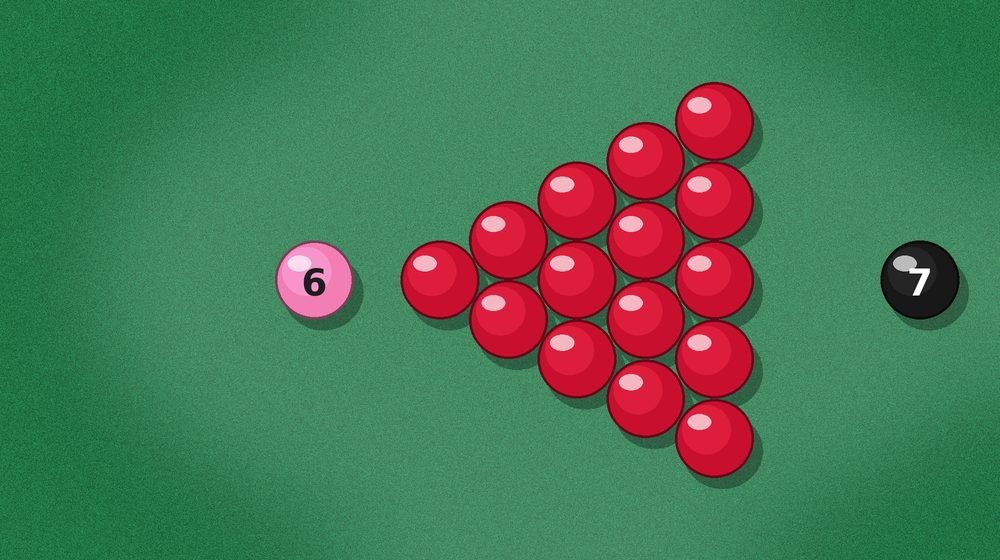
The point values rise as the colours move towards the far end of the table. The three lowest — yellow, green and brown — are on the baulk line close to the player’s starting end. The blue is in the centre. The pink and black are towards the top, with the black closest to the top cushion. A ball’s position matters because a high-value ball that is awkward to pot is a risk, while the easily accessible black is a reward worth more than the others. For a diagram-free description of the layout, see our beginner’s guide.
How a break builds up
In the first stage of the frame you alternate between a red and a colour. The most basic pair is red-then-black, worth eight points. If you pot a red and the blue, that is six; red and brown, five. Here is a short example of a break:
- Pot a red: 1 point (total 1).
- Pot the black: 7 points (total 8).
- Pot a red: 1 (total 9).
- Pot the pink: 6 (total 15).
- Pot a red: 1 (total 16).
- Pot the green: 3 (total 19), and miss the next red.
That 19-point break ended on a missed pot, and the opponent now comes to the table. A break of 50 or more is called a half-century; a break of 100 or more is a century, a major milestone for any amateur player.
Why the maximum break is 147
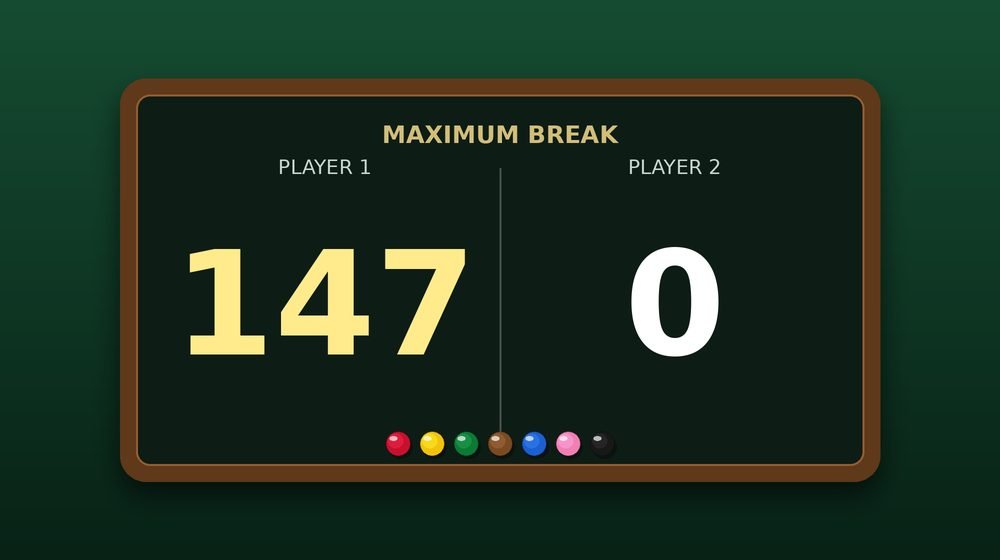
The highest break in a normal frame comes from potting every ball in the best possible order. You pot a red, then the black, fifteen times in a row: 15 × (1 + 7) = 120 points. After the last red and black, the six colours are played in ascending order: 2 + 3 + 4 + 5 + 6 + 7 = 27. And 120 + 27 = 147. That is known as a 147 or maximum break. It is rare even among professionals, and only a small number of players have made one in competition.
It is possible to exceed 147 only when the opponent has committed a foul and left a “free ball”, giving the shooter an extra chance to pot a ball as if it were a red. Such totals are not very common.
Counting the points remaining
Knowing how many points are left on the table helps you decide when to attack and when to play safe. Two formulas cover the first stage of the frame:
- If you are on a red and there are n reds left, the maximum you can still score is 8n + 27.
- If you are on a colour and there are n reds left, it is 8n + 34, because you can still take a black immediately.
With 10 reds left and a red next, the maximum is 80 + 27 = 107. Once the reds are gone, simply add up the colours that remain. If only the pink and black are left, that is 13 points.
If one player is ahead by more than the points left on the table, the other needs a foul or a “snooker” to get back into the frame. Players often concede at that point.
Foul points
Fouls give points to the opponent without any pot being required. The penalty is the value of the ball that was involved in the foul, with a minimum of four and a maximum of seven. If you hit the black first when you should have hit a red, the foul is worth seven. If you pot the white ball only, it is four. Those points add to the frame total, but they do not count towards a break, so a player’s highest break and total score can be different. Read the full list of penalties in Snooker Rules Explained.
Using ball values in strategy
High-value balls are tempting, but experienced players weigh risk and reward. A few principles follow from the numbers:
- The black is the engine of a big break. Because it is worth seven, most players try to leave themselves a route to the black after each red.
- Do not give away easy fouls. A mistake that touches the black or pink will cost six or seven points. That is almost as much as a pot, so safety play is valuable when the position is unsafe.
- Lower colours are stepping stones. Taking the yellow, green or brown is usually about cue-ball position for the next red, not about the points.
- Late in the frame, order is everything. After the reds, each colour must be played in order, so a miss on the blue can give your opponent the chance to take 5 + 6 + 7 = 18 points.
Tips for remembering the values
The values run in the same order as the colours’ positions on the table’s centre line, which helps. The sequence yellow–green–brown–blue–pink–black has values 2–3–4–5–6–7, so each step is one more than the last. It can help to say it aloud as “two, three, four, five, six, seven” whenever you take a shot until it becomes automatic. Another trick is to remember that the order of the colours never changes: yellow, green, brown, blue, pink, black — the first letters spell Y-G-B-B-P-B, and the value of each is simply its position in the list plus one.
The quickest way to lock these numbers in is to see them scored. Open our online snooker game, play a practice frame, and watch the score update as you pot reds and colours. If you want to learn how this differs from other cue sports, our comparison of snooker and pool explains why snooker’s scoring is so different from the numbered-ball system.