The rules of snooker are short to state and surprisingly rich in detail. This article sets out the essentials: what a legal shot is, how points are scored, which mistakes count as fouls and what they cost, and exactly how a frame is won. It reflects the standard international rules as commonly played; local leagues and clubs may apply small variations, so always check your own competition’s rulebook.
What makes a shot legal
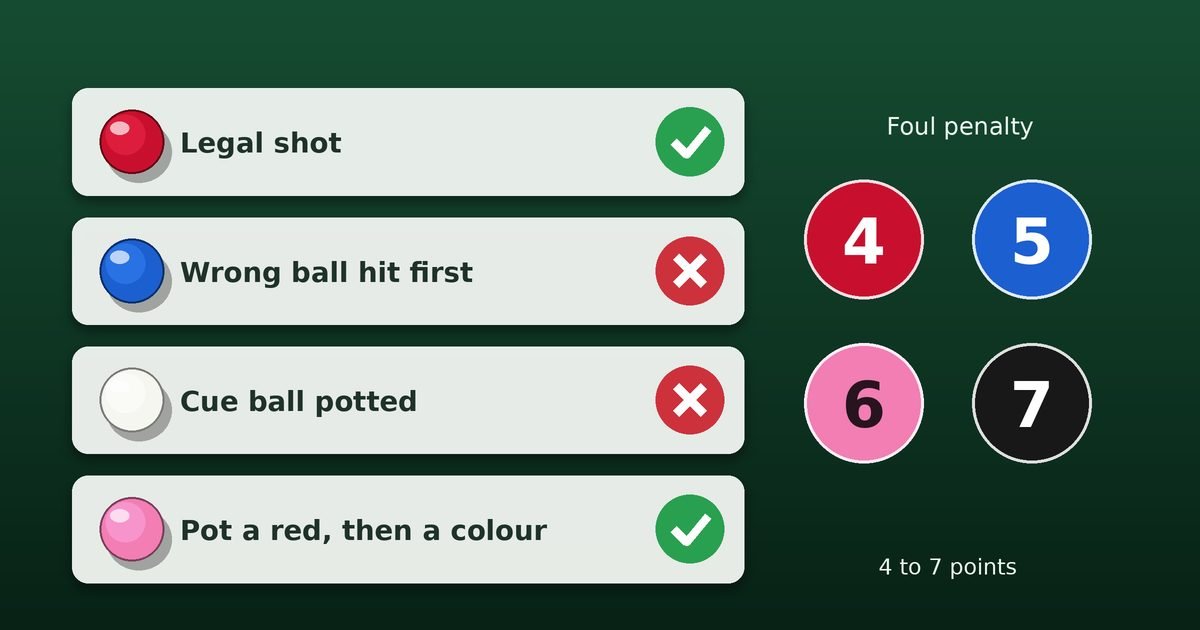
A stroke is legal when the player hits the cue ball with the tip of the cue and the first ball the cue ball touches is the “ball on” — the ball the player is currently allowed to hit. If the player is on a red, the first contact must be a red. If they are on a colour, the first contact must be a colour. The player must also avoid touching any ball with anything other than the tip of the cue, have at least one foot on the floor, and wait until all balls have stopped moving before striking.
The cue ball may touch cushions before or after striking the object ball, and it may be struck from any part of the table apart from the start of a frame or after a ball in hand, when it is played from inside the D.
The order of play
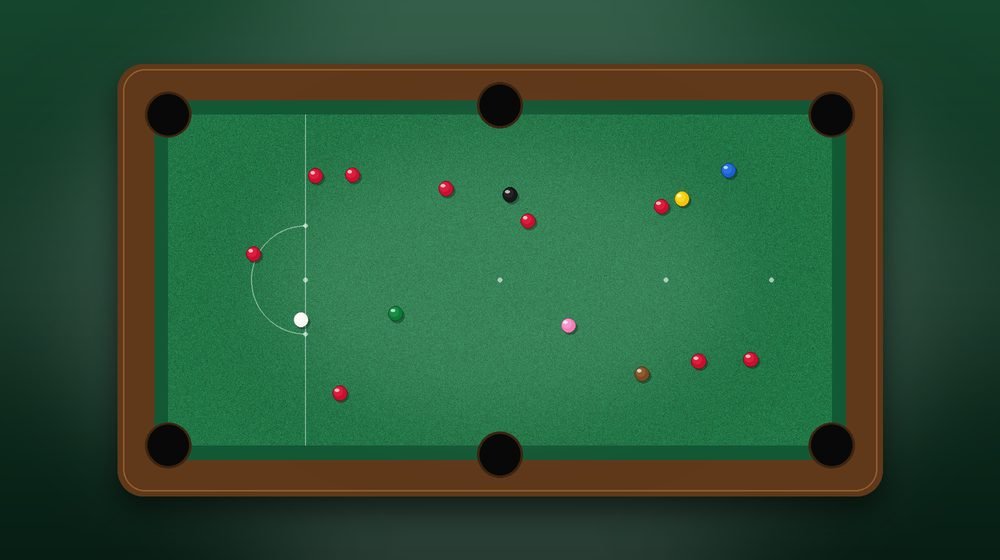
At the start of a frame, all fifteen reds and six colours are on the table. The sequence is:
- Play a red. If it is potted, the player continues.
- Nominate a colour (any of the six) and play it. If potted, it is returned to its spot while any reds remain.
- Repeat steps 1 and 2 until the reds are all off the table.
- After the last red, one final colour is taken and re-spotted, and then the colours are played in order of value from yellow up to black. They stay down this time.
The nomination is important. In professional play the referee only asks for clarification when it is unclear, but if you say or indicate “blue” and pot the pink, you have not made a legal pot. Our online game simplifies this by treating the first colour your cue ball touches as your nominated colour.
How scoring works
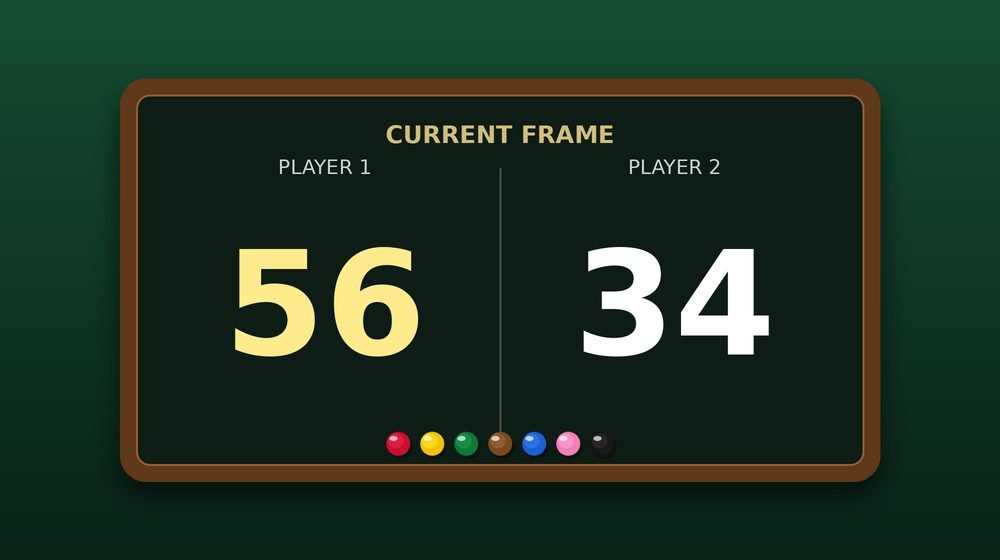
You score the value of every ball you legally pot: red 1, yellow 2, green 3, brown 4, blue 5, pink 6, black 7. Several reds can be potted in one shot, and each scores a point, but only one colour may be potted after a red. The highest achievable break without opponent errors is 147. See the complete guide to ball values and scoring for worked examples.
Points are also scored through your opponent’s fouls. These points are added to your score immediately and do not count as part of a break.
Fouls and their penalties
The penalty for a foul is the value of the ball involved, with a minimum of four points. The value is the highest of all balls involved in that stroke. So a foul that involves only a red, or only the cue ball, costs 4; a foul involving the blue costs 5; the pink costs 6; and the black, 7. Common fouls include:
| Foul | Penalty |
|---|---|
| Potting the cue ball (“in-off”) | 4, or higher if another ball was involved |
| Hitting the wrong ball first | Value of the ball hit or the ball on, whichever is higher; at least 4 |
| Failing to hit any ball | Value of the ball on; at least 4 |
| Potting the wrong ball | Value of the ball potted; at least 4 |
| Forcing any ball off the table | At least 4, up to 7 depending on the ball |
| Both feet off the floor | 4, or the value of the ball on if higher |
| Touching a ball with anything other than the cue tip | 4, or the value of the ball on or touched |
| Playing while balls are still moving | 4 or more |
| Playing a push shot (the tip touching the cue ball twice or staying on it) | 4 or more |
| Jumping the cue ball over a ball | 4 or more |
What happens after a foul
After a foul the opponent receives the points and then chooses either to play from where the balls are or to ask the offender to play again. Any colours potted on a foul stroke are returned to their spots; reds that are potted remain off the table. If the cue ball was potted, the next player takes it in hand and places it anywhere inside the D, and plays it in any direction. In our online game, a potted cue ball behaves in the same way, but we do not offer the option of making the opponent play again.
Snookers, free balls and misses
Snooker. A player is snookered when the cue ball cannot hit every part of every ball on in a straight line because another ball is blocking. Being snookered is not a foul, but it makes the next shot hard.
Free ball. If a player is left snookered by a foul, the referee announces “free ball”. The player can nominate any ball as if it were the ball on, and if they pot it, it scores the value of the ball that was really on. This is a protection against fouls creating unfair snookers and is not included in our online game.
Foul and a miss. If the referee judges that a player did not make a genuine attempt to hit the ball on, the shot is called “foul and a miss”. The opponent may then require the balls to be returned to their original positions and the shot to be played again. The rule keeps players from deliberately hiding behind blockers.
Re-spotting balls
When a colour is returned to the table it goes on its own spot. If another ball occupies that spot, the colour is placed on the highest-value vacant spot. If every spot is occupied, it goes as close as possible to its own spot, between the spot and the top cushion. The same rule is used in our game, so you can see what happens in unusual positions.
How a frame is won
The frame ends when the last ball is potted or when a player concedes. A player can concede at any time during their own turn, typically when the number of points left on the table is fewer than the points they need to catch up, and snookers cannot reasonably help them. If, after the final black is potted or fouled, the scores are level, the black is re-spotted. The players draw lots for who plays first, and the first to pot the black or force the other to foul wins. In a match, frame wins are totalled and the first to the target number wins.
Ready to see these rules in action? Try our online snooker game, which applies the red–colour sequence, scores points, awards foul points and respots colours automatically. If you are brand new, start with the beginner’s guide.