Good snooker is built on small, repeatable habits rather than flashes of talent. The ten tips below focus on the two skills that matter most — hitting the object ball where you intend, and sending the cue ball where you want it to finish. They apply whether you play on a full-size table, a pub table or our online snooker game, where you can practise your angles without needing a club.
1. Build a stable stance
Everything starts with your feet. Place your back foot roughly in line with the cue, your front foot a shoulder’s width ahead and slightly open, and bend the front knee a little. Your weight should be evenly spread so that you are not leaning on the bridge hand. A stable base means your upper body can stay still when you play. If you find that you rise up as you strike, check whether you are standing too tall or gripping the table with your front hand.
2. Make a firm bridge and a light grip
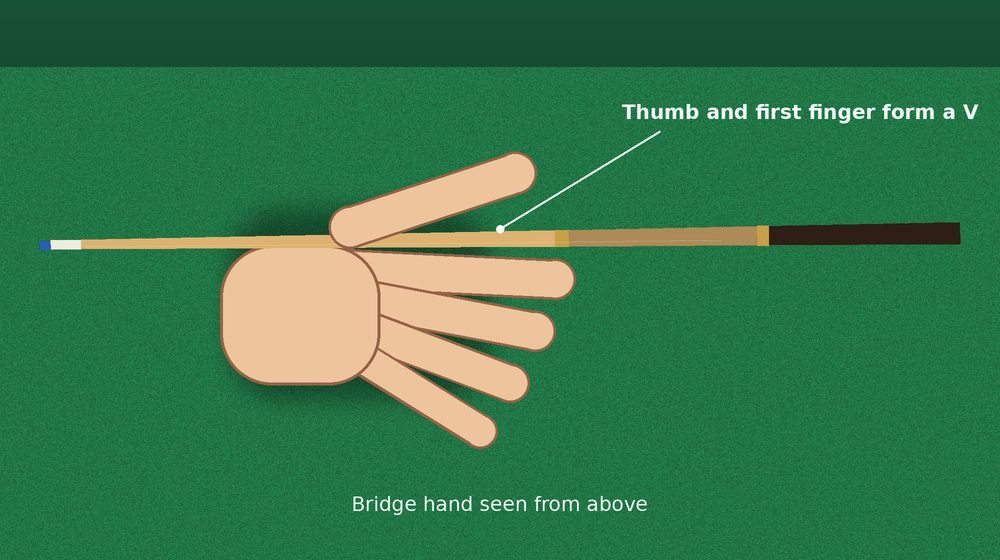
Spread the fingers of your bridge hand on the cloth, raise your thumb against the first finger, and let the cue slide in the groove. A firm bridge keeps the cue on line; a floppy one lets it drift. At the other end, hold the cue as gently as you would hold a bird: thumb and first two fingers do the work while the others rest. A tight grip makes the cue twist on contact. Keep the elbow of your cueing arm pointing down so that the forearm swings like a pendulum and nothing else moves.
3. Pause at the back of every stroke
Take a short pause when the cue is fully drawn back — a fraction of a second is enough. It lets you check that the cue is still pointing along the line and gives your arm time to start the forward stroke smoothly. After the pause, accelerate through the cue ball rather than punching at it. Players who skip this pause tend to jab, and the result is poor contact.
4. Aim with the ghost ball
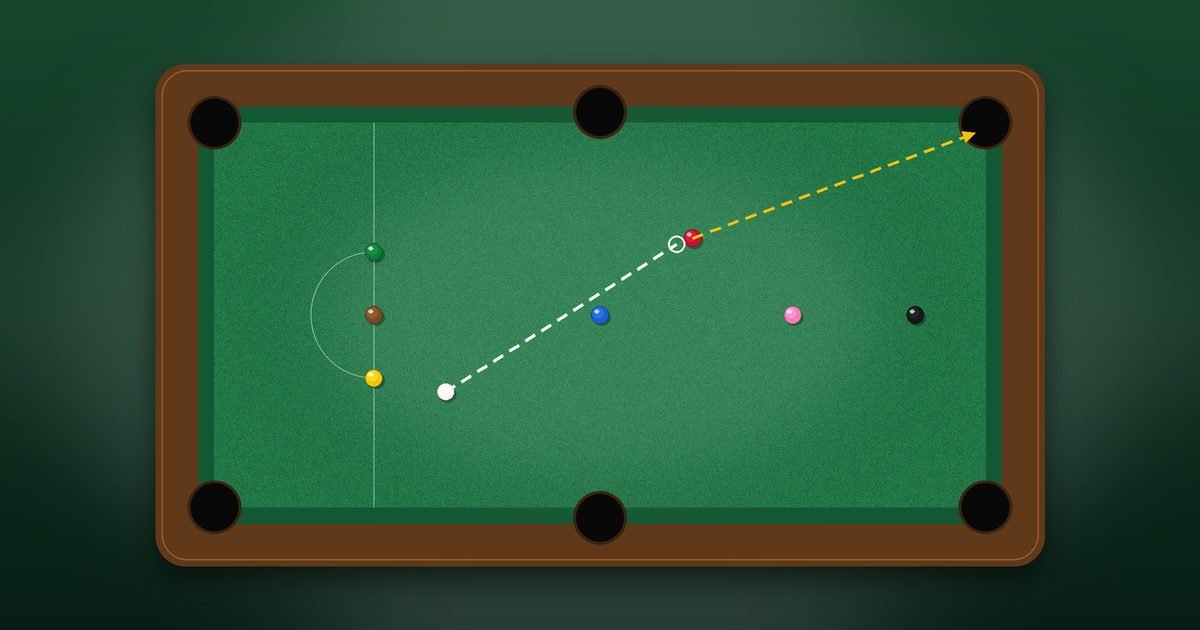
To pot an object ball, the cue ball has to arrive at the “ghost ball” position: the point where the cue ball touches the object ball on the opposite side of the pocket. Imagine a second ball sitting there, touching the object ball so that the line through both centres points at the pocket. Aim the centre of the cue ball at the centre of that ghost ball. Our online game shows this guide as a faint circle, so you can see how a slight change of angle moves the ghost ball and changes the outcome. On a real table, get into the habit of picturing the ghost ball before you bend down.
5. Keep your eyes on the object ball at the moment of contact
A common routine is to look at the object ball, then the cue ball, then back to the object ball just before you strike. Many beginners stare at the cue ball and tip. By the time you make the final stroke, your eyes should be fixed on the contact point where the cue ball will meet the object ball. This helps your brain guide the cue to the correct line.
6. Master cue-ball speed first
New players often hit too hard. Power makes every error larger and leaves the cue ball bouncing round the table. Learn to play gentle “touch” shots: pot a ball and have the cue ball finish about 30 cm from where it hit. Then try pots that need medium pace, and finally full-table shots. A good test is to place the cue ball in the D and see how close you can get it to the top cushion without touching it. Control of speed will improve your cue-ball position more than any spin.
7. Use the centre of the cue ball before trying spin
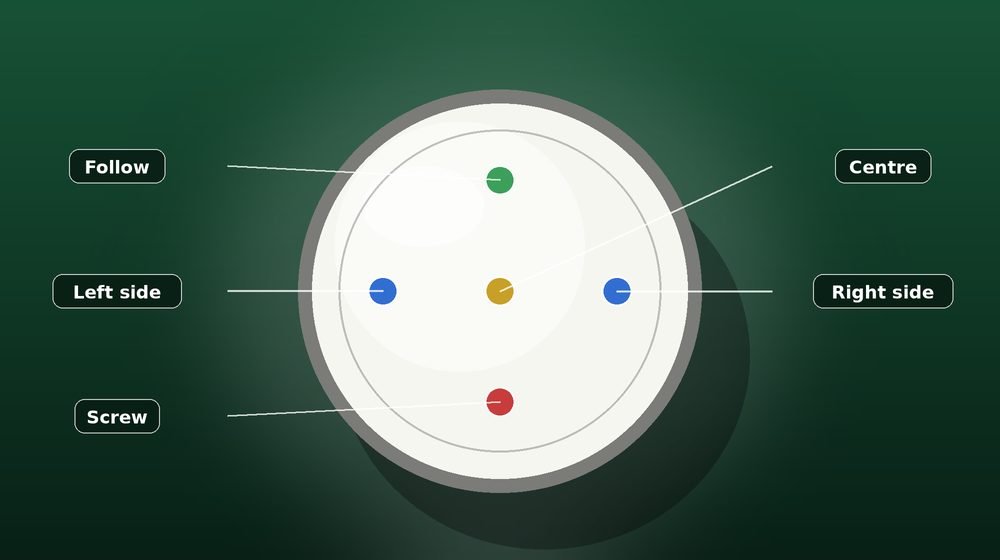
Strike the cue ball through its centre first. This produces a natural roll, and the ball travels predictably. Once you can pot with a centre-ball strike consistently, you can add vertical variations: a little above centre for follow, a little below for screw (backspin). The tip should never go more than about half the radius from the centre; extreme strikes risk a miscue, where the tip slips off the cue ball and the shot is spoilt.
8. Learn the three basic cue-ball actions
- Stun: hit slightly below centre, so the cue ball stops almost dead on impact with a straight-on pot. It is the foundation for short position play.
- Follow: hit above centre so the cue ball continues forward after contact. It is useful for getting through to the next ball.
- Screw (draw): hit below centre with a longer, smoother stroke so the cue ball spins back. It lets you return from the far end of a straight pot.
Practise each with a single red and black, noting where the cue ball stops each time. Keep notes: a few minutes of these drills teaches more than a hundred random frames.
9. Be careful with side spin
Side spin can alter the angle the cue ball takes off a cushion and can help with tricky positions, but it also causes the cue ball to swerve and the object ball to “throw” slightly off the intended line. Use it sparingly while you are learning, and when you do use it, aim a little fuller or thinner than normal to compensate. Our online game does not simulate spin, so for the moment this is a technique to try at a real table.
10. Think one shot ahead — and play safe when needed
Strong players choose a shot by thinking about where the cue ball will finish. Before each pot ask yourself: what is my next ball, and which area of the table gives me the easiest line to it? If the pot is difficult, consider a safety shot that leaves the cue ball tucked behind another ball or on a cushion. Safe play is not defensive negativity; it is the skill that stops opponents from scoring. A foul that gives away four or more points can decide a frame, as explained in our guide to fouls.
Looking after your equipment
Chalk before most shots, keep your cue straight and free from moisture, and check that your tip is slightly rounded rather than flat. A well-maintained cue gives a consistent strike, which makes the technique above easier. If you are new to the game, begin with the beginner’s guide, and check the ball values guide to plan which balls to target for the biggest breaks.