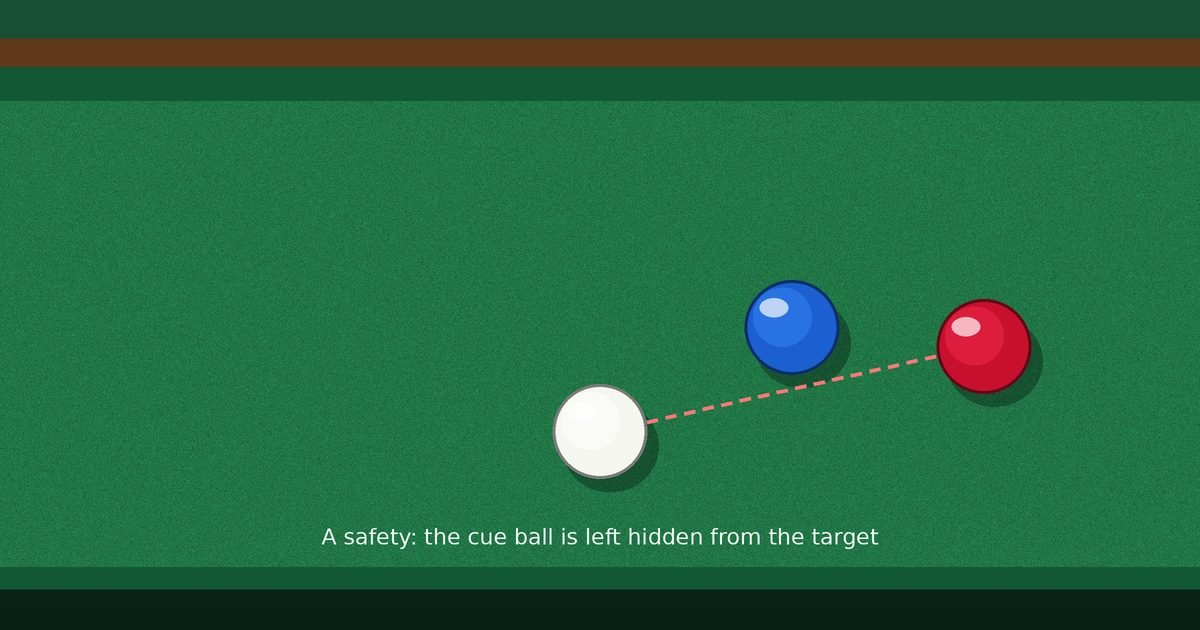
Many people picture snooker as a game of long pots and big breaks, but a large part of every match is spent not potting at all. Safety play, the art of leaving the cue ball where your opponent has no good shot, is what separates patient, tactical players from those who simply hit and hope. This guide explains what a safety shot is, when to play one, the main types of safety, how to avoid leaving a chance, and how to train the skill.
What is a safety shot?
A safety shot is a deliberate shot that has the main aim of leaving your opponent with no scoring opportunity. You may or may not pot a ball while playing it. What matters is where the balls finish. A perfect safety leaves the cue ball tucked behind another ball, or pressed against a cushion far from any red, so that your opponent has to take a risk or play a defensive shot of their own.
The idea comes straight from the structure of the game. Because snooker is a contest of points scored over many shots, and because you cannot score while your opponent is at the table, the best way to stop them winning is not to give them a chance to start. A missed pot that leaves a red hanging over a pocket gifts them the frame. A well-played safety returns the problem to them.
When to play safe
Good players ask three questions before choosing a shot.
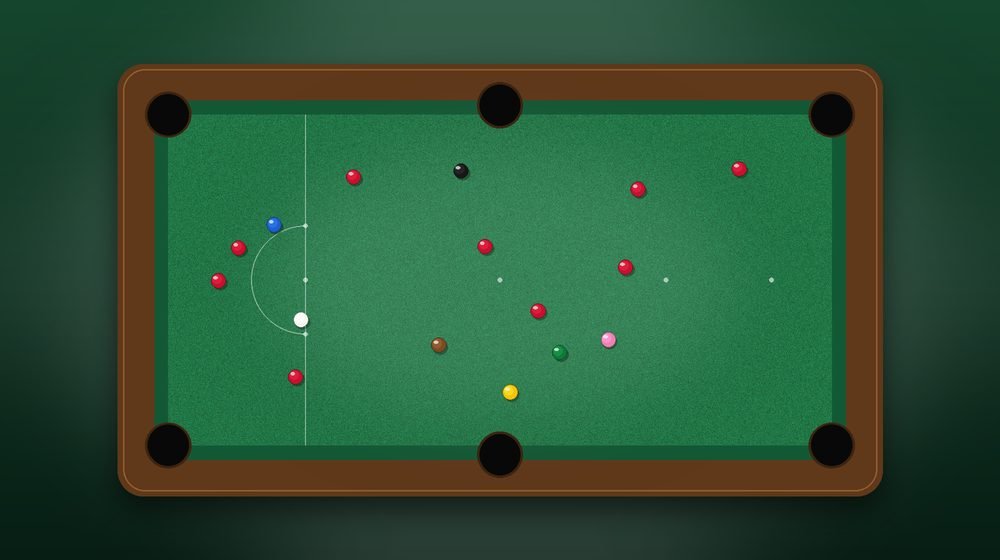
- What are my odds of potting this ball? If the pot is difficult, say a long red with an awkward angle, the chance of missing is high.
- What happens if I miss? If a miss leaves the red close to a pocket, or leaves the cue ball near the pack, the cost is high. If a miss leaves the balls tied up, the cost is low.
- What happens if I pot it? If the pot leaves the cue ball in an awkward position with no follow-up, the reward is low.
When the answers are poor, safety is the correct choice. It is not cowardice; it is risk management. Beginners often attempt shots that experienced players would not touch, and the result is a frame handed to the opponent. Learn to recognise those moments and play safe without feeling you have missed an opportunity.
A rough guide is to play safe when your chance of success is lower than about fifty per cent and when a miss would give your opponent an easy opening. The numbers are not precise, but the idea is helpful: do not take on a shot unless the risk is justified.
Main types of safety shot
There are several ways to play safe. Each has a different purpose, and a skilled player will use all of them during a match.
- The thin-contact safety. You touch a red very thinly with the cue ball and send the cue ball to a cushion, ideally back towards baulk. The red barely moves, and the cue ball returns far from the pack.
- The double-back safety. You play the cue ball off the top cushion, often with a bit of weight, so that it travels the length of the table and returns to baulk. It is useful when no direct contact is safe.
- The snooker-behind-a-colour safety. You leave the cue ball tucked behind a colour or a red, so your opponent cannot see the next ball in a straight line.
- The long safety. From baulk you play the cue ball up the table, strike a red at the back of the pack, and return to baulk. It is the standard opening safety shot.
- The cushion-to-cushion safety. You play the cue ball off one or more cushions to finish against another cushion or behind a ball.
- The pot-and-safe shot. You pot a ball and also leave the cue ball in a safe place. This combination is the ideal and is worth practising.
Each of these requires control of both speed and angle. The most common failure is hitting the cue ball too hard so that it returns to an open area instead of staying behind a cushion. If you have not yet learned about pace, our tips on aim and cue-ball control are a good starting point.
Safety from the opening exchanges
The first shot of a frame is usually a safety shot. The breaker plays from the D, tries to hit the back of the pack, and returns to baulk. The key target is a red at the corner of the triangle. By brushing the red and sending the cue ball back, the breaker avoids giving away a chance.
The opponent then faces a choice. They may reply with a similar safety, or they may try to pot one of the loose reds. Over several exchanges, the pack gradually loosens, and eventually one player gets a pot. In many frames, the early exchanges decide who has the first real chance. A player who reads the table well, and who chooses their safeties with care, will often be the one who gets the first scoring opportunity. If you want to know what that opportunity might lead to, read our break-building guide.
Using safety to create snookers
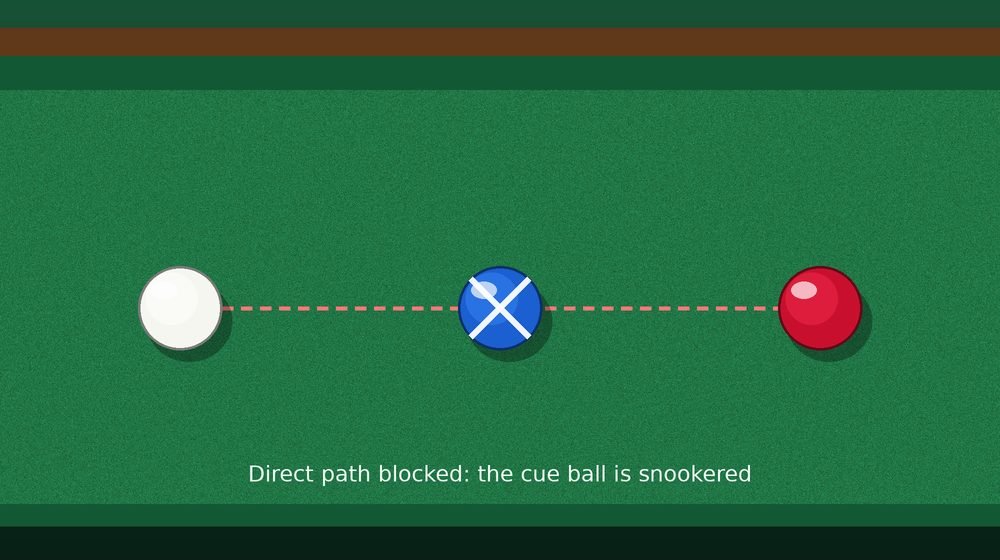
A snooker, in the rules sense, is a position where the cue ball cannot hit the ball it is supposed to play in a straight line because another ball is in the way. A safety shot that leaves your opponent snookered forces them to attempt an escape, and escapes are difficult. If they fail, they concede a foul, and the points are yours. Our dedicated guide to snookers and escapes covers how to do this and how to get out.
Creating a snooker is not just about the position of the cue ball. You also have to think about what is left on the table. A snooker behind the black may be effective in the late stages of a frame, because the number of balls is small, and the possibilities are limited. In the early stages, a snooker behind a red is often less effective, since the number of reds provides many angles.
How to play a good safety
A safety shot is a small, careful stroke. These habits will help.
- Decide the finishing position first. Know where you want the cue ball to end up before you pick up the cue. Then work back to find the contact and speed.
- Use soft, controlled speed. The same shot at two different speeds leaves entirely different positions. Many safeties are played at the same weight as a gentle roll.
- Pick the contact point carefully. A thin contact on one side of a red sends the red one way and the cue ball another. Visualise both paths.
- Think about both balls. You are controlling the cue ball and the object ball. Both must finish in good places.
- Stay still through the shot. Safety shots are delicate. A small movement of your body or head can change the contact.
Cue-ball spin can help. A little backspin, applied by hitting below centre, can pull the cue ball back after contact. A little topspin can carry it forward. Both techniques are explained in our cue-ball spin guide. Even so, a beginner should first master the plain, central shot before experimenting with spin.
Rules to remember
Safety play still has to obey the rules. In particular:
- The cue ball must first hit a ball that is “on”, usually a red when reds remain, or the lowest-value colour when only colours are left. Hitting the wrong ball first is a foul.
- After contact, either a ball must be potted, or the cue ball or any object ball must hit a cushion. A shot where nothing reaches a cushion and nothing is potted is a foul.
- If you miss repeatedly in a situation where it is clear that you are not trying to hit the ball, the referee can call a “foul and a miss,” and your opponent can ask you to play again. The rule is meant to prevent a player from making no effort to hit a ball when they are snookered.
For a complete list of fouls and their penalties, see Snooker Rules Explained.
Common safety mistakes
- Leaving the cue ball in the open. The most common error. Always ask whether your opponent can see a red from where the cue ball stops.
- Hitting too firmly. Extra speed means more chances for the balls to roll into a bad place.
- Forgetting the object ball. A red that rolls off the pack and sits near a pocket is an invitation.
- Playing safe at the wrong moment. If your opponent has just left an easy pot, take it. Safety is a tool, not a rule.
- Playing safe too often. The opposite problem. If you never take on a pot, you will never build a break.
Training safety play
Safety is easy to practise alone. Place the reds in a pack, put the cue ball in the D, and play a long safety shot. Aim to finish with the cue ball inside baulk, touching or close to the cushion. Count how many times in ten you succeed. Next, position a red near the middle pocket and try to leave the cue ball behind the black or a colour. Slowly make the targets smaller. You will find that your touch develops quickly, and your tactical sense with it. More ideas can be found in our guide to snooker practice drills.
The best players treat safety as an equal partner to potting. The sooner you do, the sooner your results will improve.