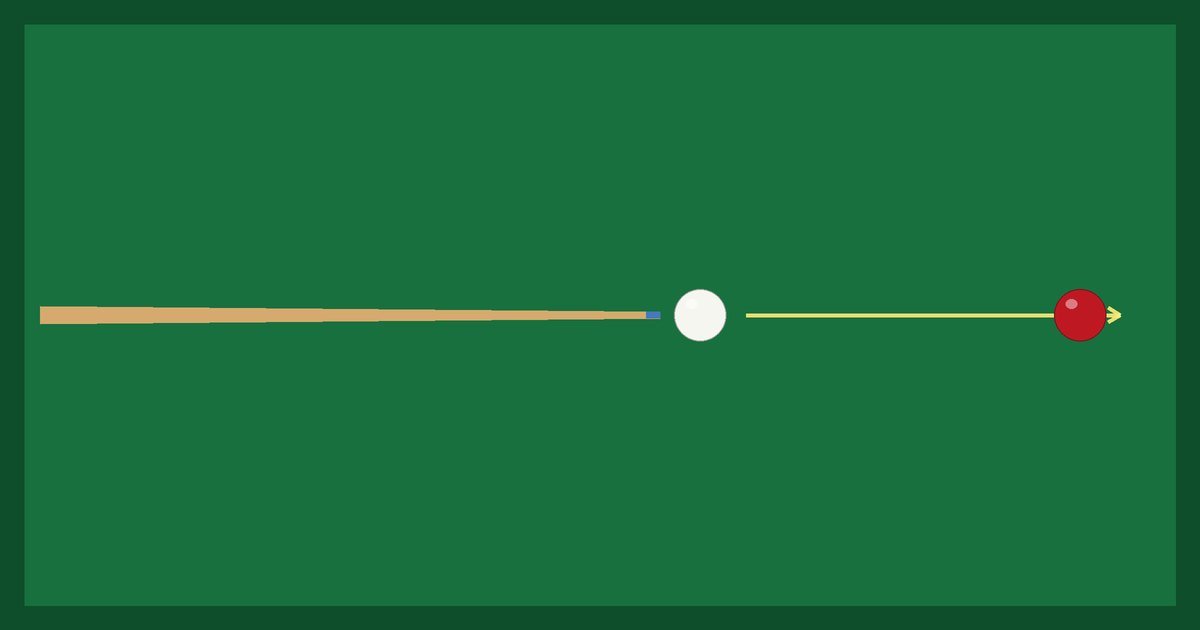
Aim, stance and bridge all matter, but none of them will help if the cue does not travel straight through the cue ball. The cue action, the way your arm swings the cue back and forwards, is the engine of every shot. A smooth, repeatable action makes potting, spin and position feel easier; a jerky or wandering one makes every shot a gamble. This guide breaks the stroke into its parts, explains what to look for in each, lists the faults most players develop and gives drills to fix them.
The pendulum idea
The simplest way to understand a good snooker stroke is to picture a pendulum. Your upper arm stays almost still, your elbow acts as the pivot, and only the forearm swings the cue backwards and forwards in a straight line. At the moment the tip meets the cue ball your forearm should be hanging roughly vertically below the elbow, with the cue at a right angle to it. Hitting the ball at this point gives the most consistent contact, because the cue is moving at its most controlled and straight.
That is why your grip-hand position along the cue matters. If you stand and grip so that your forearm is vertical when the tip is at the cue ball, the stroke is naturally straight. If you grip too far forward or too far back, the forearm is angled at impact, and the cue is forced to swing in an arc or to be steered.
The grip
Hold the cue lightly. A tight fist creates tension that travels up the arm and makes the cue wobble. Most coaches suggest:
- Wrap the thumb and first two fingers around the cue, with the remaining fingers resting loosely beside them.
- Keep the grip firm enough to control the cue, but not so firm that your knuckles whiten. Many players think of holding a small bird: enough pressure that it cannot escape, not enough to hurt it.
- Keep the wrist relaxed, so that it can follow the cue naturally through the stroke instead of snapping or twisting.
Your hand will tighten when you are nervous, so check your grip during pressure moments. It is one of the first things to go wrong when the mental game slips, as discussed in our guide to focus and handling pressure.
Cue height and level
Keep the cue as level as the table and your bridge allow. A cue that is pointing sharply downward when you strike can add unwanted spin or make the cue ball bounce; a level cue sends the ball along the cloth cleanly. The more elevated your butt, the more likely the cue ball will deviate from the line you aimed along. If a shot forces you to raise the butt, for example over another ball, play it gently and learn how your cue behaves on such shots. Our bridge and rest guide explains how bridge height affects the cue’s angle.
The stroke in four stages
1. Sighting strokes
Before the final shot, play a few slow, smooth practice strokes with the tip close to, but not touching, the cue ball. Use them to settle the cue on the line, to check your tip position and to rehearse the pace of the shot. Two or three are usually enough; too many drain focus.
2. Backswing
Draw the cue back smoothly along the line of the shot. A short backswing suits soft shots and a longer one suits power shots, but in both cases the cue should travel in a straight line, close to level, without drifting sideways. Keep your head still and your elbow quiet.
3. The pause
Many top players briefly pause at the back of the stroke. The pause removes the jerk that sometimes happens when the cue changes direction, lets you check your alignment and gives you a moment to commit. It is short, a heartbeat, not a long hold. It should feel like a smooth transition, not a stop.
4. Forward stroke and follow-through
Accelerate gently through the cue ball rather than jabbing at it. The cue should be moving at its fastest as it hits the ball, and should continue forward after contact. A follow-through of at least one cue-ball width, and often more for firm shots, shows that the cue accelerated through the ball and did not decelerate before contact. Stay down in your stance until the cue ball has hit the object ball. Standing up early is among the most common causes of missed pots.
Common cue-action faults and fixes
| Fault | Typical effect | Possible fix |
|---|---|---|
| Gripping too tightly | Wobbly cue, poor feel for pace | Relax the fingers; check grip before each shot |
| Jabbing at the ball | Poor pace control, miscues | Pause at the back; accelerate smoothly |
| Elbow drifting out or dropping | Cue swings in an arc; misses to one side | Keep the upper arm still; use a mirror or video |
| Cue not level | Unwanted spin, ball jumping | Lower the butt; check bridge height |
| Stopping at the ball | Dead-sounding shots, weak position | Follow through for at least a ball width |
| Swaying or lifting the head | Misaligned cue, inconsistent contact | Stay down until the object ball is struck |
When you work on a fault, change only one thing at a time. If you try to fix your grip, your elbow and your follow-through all at once, you will not know which change helped and your potting will suffer for a while. Accept that a technical change usually feels awkward for several practice sessions before it settles in.
The straight-cue drill
This is the classic test of a straight cue action. Place the cue ball on the baulk line, in the centre of the D, and aim it along the centre line of the table towards the pink and black spots. Play it firmly to the top cushion without spin, and watch it return. If your cue action is straight, the white should come back to your cue tip, or very close to it. If it drifts left or right, your cue is moving off line, or you are hitting the ball left or right of centre.
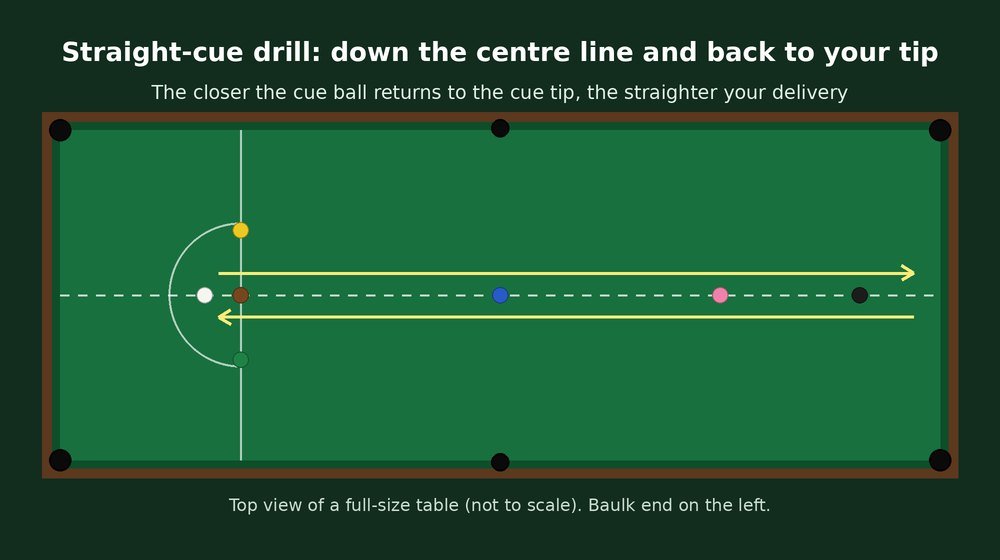
Play ten shots and note how many come back within a ball’s width of the tip. Over a few weeks you should see the number rise. Many players find that a little tension creeps into the shot as soon as they start counting, which is a good sign that this drill is testing the right thing.
Use video to see what you cannot feel
A cue action can feel straight and look anything but. Ask a friend to film you from behind and from the side, or set a phone on a stable surface. When you watch the playback, look for these things:
- Does the cue move back and forward in a straight line, or does it swing in a curve?
- Is the upper arm still, or does it swing?
- Is the cue level, and does your head stay still?
- Do you follow through, and do you stay down until the shot is complete?
Even a few minutes of footage often reveals a habit that you could not feel at the table.
Equipment and cue action
Your cue affects your action more than many players realise. A cue that is too heavy or too long for you will encourage a tight grip and an erratic swing, and a poorly shaped tip can cause miscues even when your technique is good. If your action feels uncomfortable, check the length and balance of your cue and the condition of the tip. Our cue buying guide explains what to look for.
Putting it into a routine
Technique only counts if it survives the pressure of a match. The best players use the same routine every time: assess the shot, walk in along the line, get down, play two or three sighting strokes, pause, deliver, stay down. The routine ensures that your cue action is the same on an easy pot as on the frame-deciding shot. If you want to improve your technique, practise this sequence with every shot, even in casual games, until it becomes automatic. When you want to practise without a real table to hand, our online snooker game lets you work on pace and timing, and the ten practical tips give you more ideas to test each time you play.