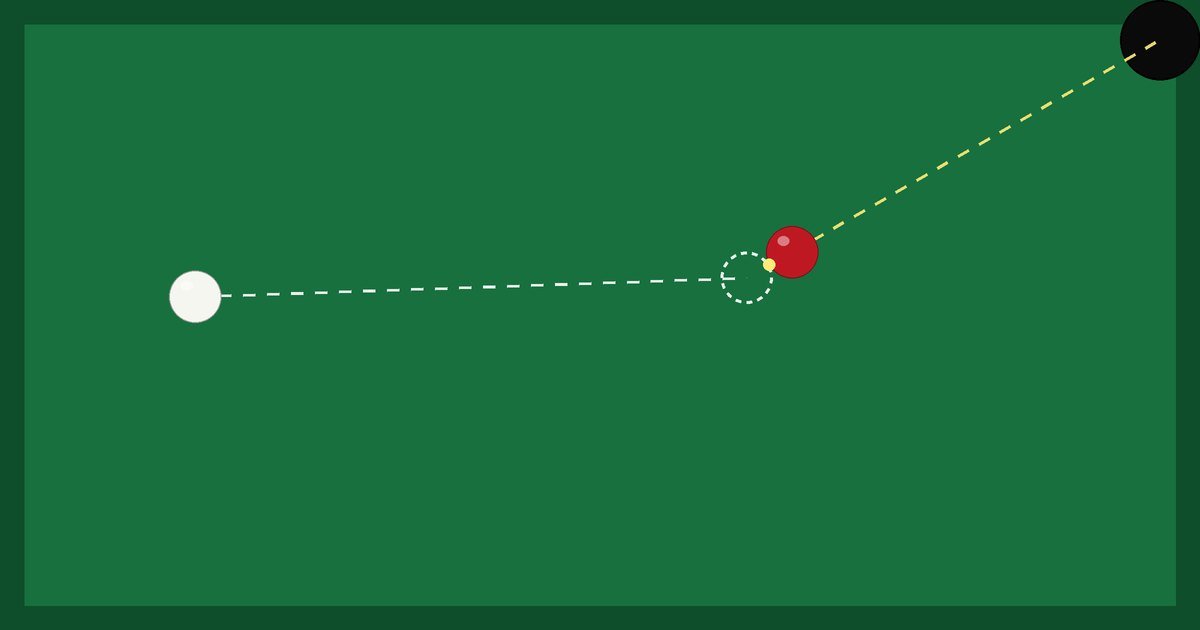
Every pot in snooker comes down to one question: where must the cue ball hit the object ball so that the object ball travels into the pocket? Answer that correctly and deliver the cue straight, and the ball drops. Be a few millimetres out, and it rattles the jaws or misses altogether. This guide explains how potting angles work, how to think in fractions of the ball, how to find the contact point on any shot, and which habits cause the most missed pots.
The contact point and the ghost ball
When the cue ball strikes an object ball, the object ball sets off along the line that joins the two centres at the moment of impact. That single fact is the foundation of all potting. To send the object ball to the pocket, the cue ball must arrive with its centre on the line that runs from the centre of the pocket, through the centre of the object ball, and out the other side, exactly one ball diameter behind the object ball.
Players call that imaginary position the ghost ball. The spot on the object ball’s surface where the cue ball touches it is the contact point, and it sits directly opposite the pocket. Your job is to aim the centre of the cue ball at the centre of the ghost ball.
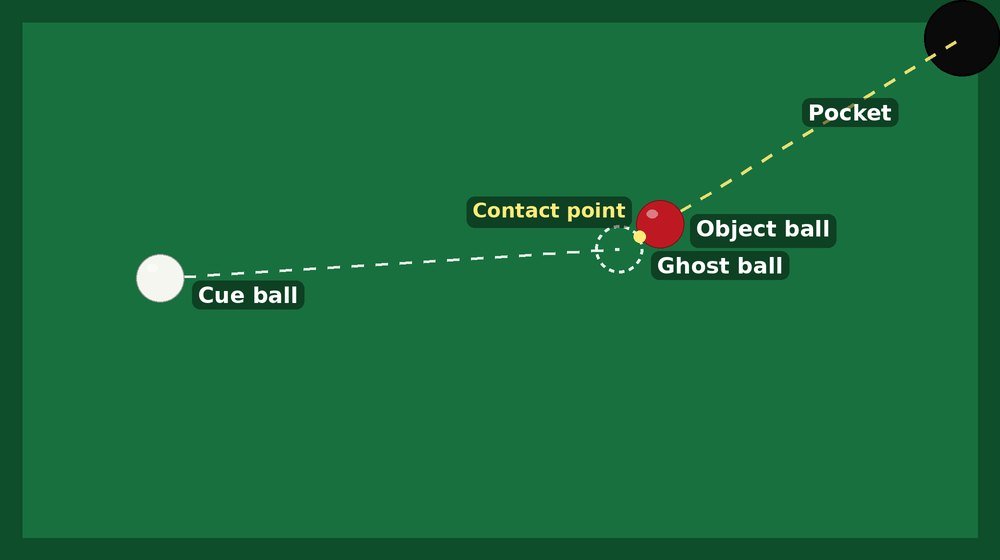
This is where many beginners go wrong. They aim at the pocket, or at the middle of the object ball, and both work only for a perfectly straight shot. On every other shot you must aim at a point beside the object ball’s centre. Our ten practical tips introduce the ghost-ball idea briefly; here we go deeper.
Thinking in fractions of the ball
Picturing a ghost ball is accurate but hard to do at distance, so most players also think in fractions: how much of the object ball does the cue ball overlap when they touch? A full-ball hit sends the object ball straight ahead. As you hit less of the ball, the cut angle grows. For two equal balls the relationship is exact: the sine of the cut angle equals the portion of the ball that is not covered.
| Contact | Ball covered | Approximate cut angle | What it feels like |
|---|---|---|---|
| Full ball | All of it | 0° | Straight pot |
| Three-quarter ball | ¾ | 14.5° | A gentle cut |
| Half ball | ½ | 30° | The most common angle |
| Quarter ball | ¼ | 48.6° | A thin cut |
| One-eighth ball | ⅛ | 61° | Very thin; risky |
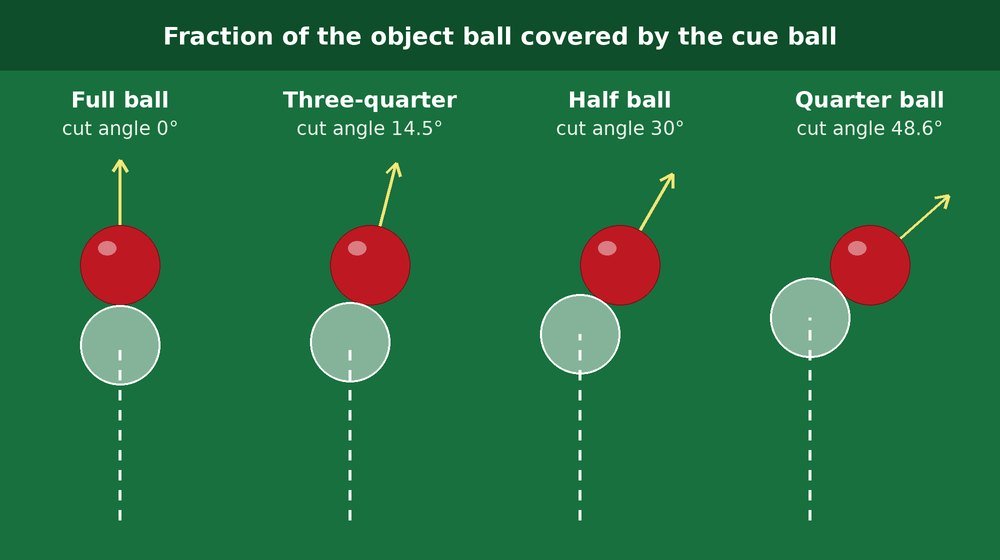
These numbers are a guide, not a guarantee. Real cloth, chalk and ball surfaces cause a little “throw”, so the object ball can leave slightly fuller than geometry predicts, especially on slow shots. The fractions give you a reliable starting point; hours of practice teach you the small corrections for your own table.
Getting your body on the line
Seeing the correct line is only half the job. You must then get down onto it without losing it. A routine that works for many players is:
- Stand behind the object ball and look along the line from the pocket through the ball. Fix the contact point in your mind.
- Walk in along that line towards the cue ball, keeping your eyes on the contact point.
- Step into your stance so that the cue, your chin and your aiming eye all sit over the line of aim.
- Play a few smooth sighting strokes, looking from the cue ball to the object ball, then pause at the back of the stroke with a final look at the object ball before you hit.
If the line feels different once you are down, stand up and start again rather than adjusting while crouched. Small shifts of the head or shoulders are enough to ruin the aim. Your cue action then has to keep the cue travelling along that same line, and the way your eyes line up over the cue matters too, as explained in our guide to vision and the dominant eye.
Pockets: where to aim
A corner pocket mouth is only about 8.5 cm wide, a little over one and a half ball widths, and its jaws are rounded. The safest target for an ordinary pot is the centre of the pocket mouth, not the near jaw. Aim at the centre and you have a small margin of error on either side; aim at a jaw and any mistake sends the ball into the cushion.
Middle pockets are wider on paper, but the cushions on either side are straight, so the range of angles that will let a ball in is much narrower. Treat a middle-pocket pot with a large cut angle with caution, and prefer to take the pot from a position that gives a straighter entry. For the layout of the pockets and cushions, see our guide to table dimensions and layout.
Why distance and thin cuts are harder
Small errors grow with distance. A one-degree error in the direction of the object ball moves it about 3.5 cm off line after two metres, which is nearly half the width of a corner pocket mouth. On a mid-range cut, a slip of only about a millimetre in where the cue ball meets the object ball can change the object ball’s direction by roughly a degree. That is why long pots demand a precise stance, a straight cue and a calm routine.
Thin cuts are harder for a related reason. When you hit only a sliver of the object ball, a tiny change in contact makes a large change in direction. Where there is a choice, take a fuller contact or play a safety instead. The question “Can I make this pot, and where does the white end up if I miss?” is central to good tactics, as we explain in the safety play guide.
Pace and the pot
Speed changes how forgiving a pot is. A ball that arrives at the pocket at a gentle pace can drop even if it touches a jaw, while a fast ball is more likely to bounce out. On the other hand, a very slow shot is affected by the cloth: the ball can drift with the nap or be deflected by a speck of chalk. For most pots, a medium pace, just firm enough to carry the object ball a short distance past the pocket if it missed, is a good compromise. Long pots need more speed to reach the pocket accurately, and then the cue-ball control becomes the main challenge.
When you add side spin, remember that the cue ball is nudged slightly away from the line you aimed along. Allow for this by aiming slightly towards the side of the cue ball you are striking; the exact amount depends on your cue, the pace and the distance, so learn it by practice. Avoid side spin altogether on difficult pots until your technique is reliable. See the spin guide for how much compensation to expect.
Common aiming mistakes
- Aiming at the pocket. Aim at the ghost ball or contact point, never straight at the pocket on a cut.
- Changing the line when you get down. Check the line from your stance and, if it moved, stand up and reset.
- Cutting too fine. Players often under-cut thin shots because they cannot see enough of the contact point. Take extra time on thin cuts.
- Steering the cue. Swerving the tip at the last moment to “correct” the aim usually makes things worse. Trust the line you set.
- Looking up early. Lifting the head to see the pot drop moves the cue. Stay down until the cue ball has hit the object ball.
- Ignoring the next shot. A good pot that leaves the cue ball badly placed still costs you the frame. Link every pot to a plan, as covered in our break-building guide.
How to practise potting angles
Put a red about a foot in front of a corner pocket. Place the cue ball roughly a foot and a half behind the red and move it so that you need a full ball, a three-quarter ball, a half ball and a quarter ball in turn, on both the left and right sides. Take ten shots from each angle and write down how many you pot. You will quickly see which angles and which side are weakest, and you can then spend more time on those. Once your scores improve, lengthen the distance a little and repeat. More drills are collected in our practice drills guide.
Finally, remember that potting is a skill you can test in any spare moment. Our free online snooker table lets you practise lining up pots and judging angles at any time, so you can build your eye for the ghost ball before you return to a real table.