
Ask professional snooker players what separates the best from the rest and many will not talk about cue action or cue-ball control. They talk about the mind. Snooker is a game of long periods of waiting, tiny margins and exposure: when you miss, you sit in your chair and watch your opponent take the frame. This guide looks at the mental side of the sport, including concentration, pre-shot routines, handling nerves, recovering from mistakes, tactical thinking and healthy habits for improving your mindset.
Why the mind matters so much
Few sports ask a player to be so still and so exact. A professional break may involve thirty or forty shots, each demanding precise judgement of angle and speed. An error of a millimetre or two in the contact point can send a ball wide of the pocket. Because the margins are so small, anything that disturbs your concentration, whether a worry, a noise or a sudden doubt, can change a shot.
Then there is the waiting. A player who misses an easy pot may sit for ten or fifteen minutes while their opponent makes a century. When their turn comes again, they must settle quickly and play at their best. That combination of inactivity and instant demand is one of the sport’s defining challenges. Recreational players feel the same on a smaller scale: you have the cue in your hand for one visit, and you want to make it count.
Build a pre-shot routine
A pre-shot routine is a fixed sequence that you follow before every shot. It prepares your body and mind, and it keeps you steady when the pressure rises. A typical routine looks like this:
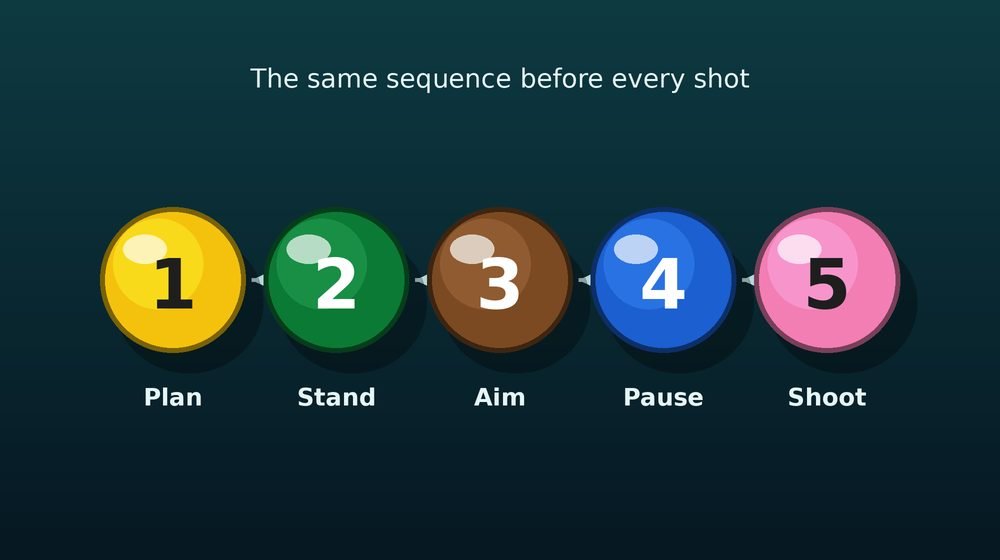
- Stand behind the shot and look at the line from the cue ball to the object ball and the pocket.
- Decide the shot: the contact point, the pace, any spin and the position you want next.
- Chalk the cue, a small habit that calms the hands.
- Step in along the line of the shot, settle into your stance and set the bridge.
- Make a few smooth practice swings, keeping the cue level, and look at the object ball, then the cue ball, then the object ball once more.
- Pause, then deliver the cue and hold your follow-through until the ball has stopped.
The details are personal, but the principle is consistency. When you stick to the same routine every time, you create a reliable mental rhythm. The routine also gives your mind something specific to do, which leaves less room for worry. If you want to work on your stance and bridge at the same time, see our bridge guide.
Concentration and sitting out
Concentration is not a constant state of intense effort. It comes and goes, and the best players learn to switch it on at the right time. A useful idea is to think of your attention as a dial: turn it up as you approach the table, and turn it down while you sit.
- While seated, relax. Breathe slowly, loosen your shoulders and let your mind rest. Watching every move your opponent makes can leave you drained when it is your turn.
- Stay engaged in a light way. Observe where the balls go, think about how the table is developing and picture what you would do next.
- Stand up in good time. Take a moment to stretch and prepare, so that you are ready when your opponent finishes.
- Avoid distractions. Switch off your phone and avoid conversations that pull you away from the frame.
When your attention drifts during a shot, step back and start your routine again. There is nothing wrong with taking a few extra seconds. It is much better than playing with a wandering mind.
Handling nerves and pressure
Nerves are normal, and they mean you care. The problem is not the feeling of tension but how you respond to it. Under pressure, the body tends to speed up: breathing becomes shallow, muscles tighten and the stroke gets quicker. The cure is to slow things down deliberately.
- Breathe out slowly before the shot. A long exhale lowers the heart rate and relaxes the shoulders.
- Keep your grip light. Tension in the hands is the first sign of nerves. Check your grip, and loosen it.
- Take your normal time. A rush is a sign that you are not in control. Stick to your routine.
- Focus on the process. Think about the contact point, the pace and the follow-through, not the score or the prize.
- Accept the feeling. Telling yourself not to be nervous often makes things worse. Acknowledge the nerves and carry on with the plan.
The more often you play under pressure, the easier it becomes. Enter small tournaments, play for something small with friends or set yourself challenges in practice. Our practice drills guide includes ways to add pressure by keeping score and setting targets.
Recovering from mistakes
Every player misses, and every player makes bad decisions. What matters is how quickly you recover. The danger is the emotional spiral: you miss an easy pot, you get annoyed, you rush the next shot and you miss again.
A simple technique is the “reset”. After a mistake, allow yourself a few seconds of frustration, then let it go. Take a breath, look at the table, and ask a practical question: what is the best thing I can do from here? Often the answer is to play a safe shot and wait for another chance. A frame is long, and a single error rarely decides it.
It also helps to treat mistakes as information. If you keep missing a particular type of shot, that is a pointer to what to practise. Rather than blaming yourself, make a note and work on it. Many champions have said that the ability to forget a missed ball and focus on the next one was crucial to their success.
Making good decisions
Mental strength is not only about staying calm. It is also about choosing sensible shots. Common decision errors include:
- Taking on a shot that is too hard because you are frustrated or behind.
- Playing safe too often because you are afraid of missing.
- Ignoring the score. When you are well ahead, it makes sense to reduce risk, and when you are behind it makes sense to take more chances.
- Changing your plan midway, which leads to a muddled shot.
The solution is to make decisions calmly and early. Choose your shot while you are standing, before you step in. Once you are down on the shot, commit to it. If you have doubts, stand up and rethink. The guide to safety play helps you judge when to attack and when to defend.
Building confidence
Confidence grows from evidence. When you have practised a shot many times and succeeded, you trust it. That is why practice is as much a mental tool as a technical one. Keep a record of your good results, and remind yourself of them before a match.
- Set realistic goals. Aim to improve your average break by a few points, not to win every frame.
- Celebrate small wins. A good safety or a tricky pot deserves a moment of satisfaction.
- Use positive, specific self-talk. “Smooth stroke, follow through” is more useful than “do not miss”.
- Visualise success. Before a shot, picture the cue ball’s path and the ball dropping in. It prepares your mind.
Playing different opponents
Opponents affect your mindset. Against a stronger player, you may feel pressure to do something spectacular. The best approach is to play your own game and treat each frame as a fresh start. Against a weaker player, there is a risk of complacency, so do not take shots lightly. Against a slow, careful opponent, avoid getting impatient; stay with your routine. Against a fast player, do not be rushed into their pace.
Good sportsmanship also supports a calm mind. Courtesy at the table, such as admitting fouls and acknowledging good shots, reduces tension and builds respect. Our guide to snooker etiquette covers these habits.
Healthy habits away from the table
Mental performance does not start at the table. Sleep, food and exercise all influence concentration. Try to get a good night’s rest before an important match, eat a balanced meal beforehand and stay hydrated. Light exercise helps keep the body flexible, which matters for those long hours in a bent posture. And remember that snooker is a game: a bad result is not a verdict on your worth. Keep perspective, enjoy the process and let your game grow at its own pace.
If you are just starting out, take the pressure off and begin with our complete beginner’s guide. The mental game will develop naturally as you play more.