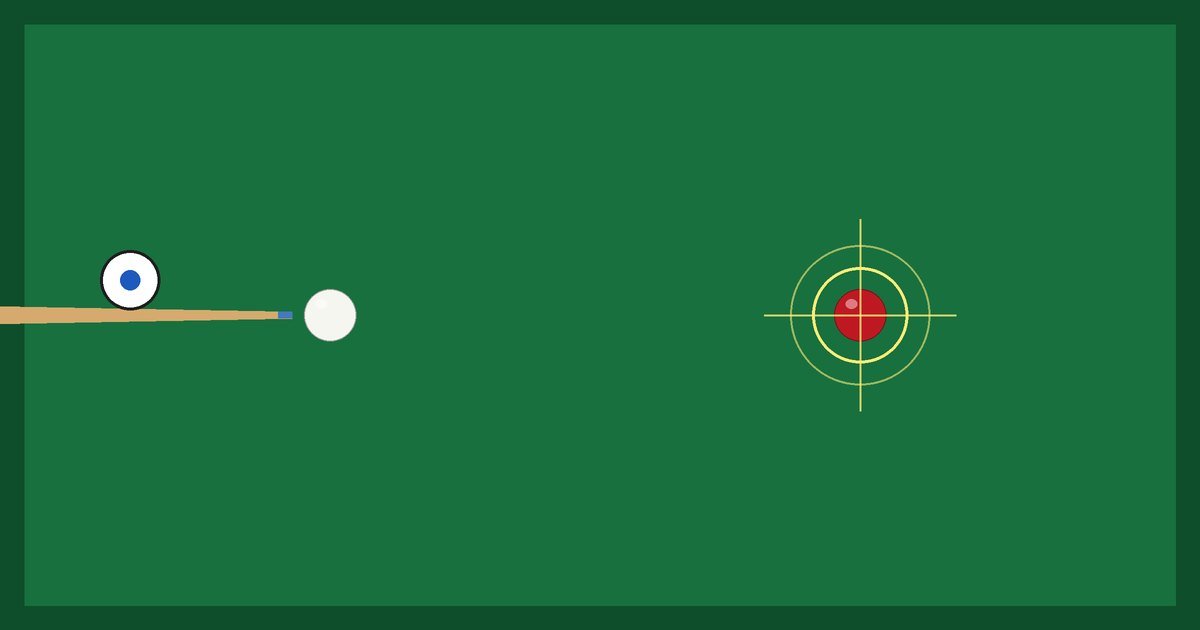
Snooker is a game of tiny margins, and almost every one of them begins with what you see. If your eyes are not properly lined up with the cue, the shot you believe you are playing and the shot you actually play can be a few millimetres apart, which is enough to miss a pot at distance. This guide looks at how vision affects aiming: what the dominant eye is, how to find yours, where to place your head and chin, how to move your eyes during a shot, and how lighting and glasses come into it.
Why your eyes matter so much
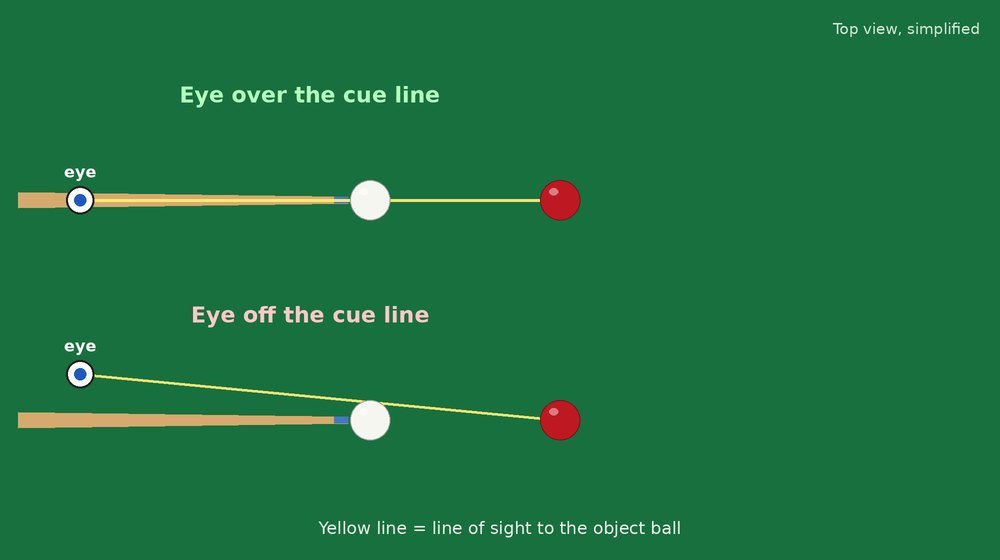
Aiming means connecting three things: the line along which the cue travels, the line from the cue ball to the contact point on the object ball, and the line your eyes see. If all three coincide, the shot looks as it really is. If your eyes look along a slightly different line from your cue, the table looks distorted: a line that seems straight to you is actually angled, and you either compensate unconsciously or miss in the same direction again and again.
That kind of consistent error, always missing to the same side, is a classic sign of an alignment problem rather than a poor cue action. Checking it is much faster than rebuilding your stroke, and it is well worth doing before you spend hours on drills. If you are not sure whether the fault lies in your alignment or your delivery, read about the cue action alongside this guide.
What is the dominant eye?
Most people use one eye a little more than the other when they line something up. This is the dominant eye. It is not necessarily on the same side as your dominant hand: a right-handed player can have a dominant left eye, which is called cross-dominance. Being cross-dominant does not stop anyone from playing well, but it can change which head position feels most natural.
A simple test to find your dominant eye
- Pick a small, distant object, such as a light switch or a clock on the wall.
- With both eyes open, stretch your arms out and form a small triangular opening between your thumbs and forefingers.
- Look at the object through the opening, keeping both eyes open.
- Slowly bring your hands towards your face while keeping the object in view.
- The opening will come to rest in front of one eye. That is usually your dominant eye.
Repeat the test two or three times to check that the result is consistent. If you get different answers each time, you may have little eye dominance at all, which is also common and perfectly fine. This is an informal test, not a medical one; if you have any concerns about your eyesight, see an optician.
Head and chin position
Most coaches teach getting the chin low and placing the cue directly beneath it, so that the cue, chin and eyes are all aligned over the line of aim. Your eyes should sit about the height of the cue plus a few centimetres, so that you can see along the cue like the sights of a gun. From there, your dominant eye plays a role:
- If your dominant eye is on the same side as your cue arm (for example, a right-handed player with a dominant right eye), the dominant eye is naturally close to the cue line. Most players in this situation find that placing the cue under the chin works well.
- If you are cross-dominant, your dominant eye is further from the cue line. Some players tilt or shift the head slightly so that the dominant eye sits closer to the line; others keep the chin centred and learn to trust the line they see. Neither is wrong.
The way to decide is by testing, not by theory. Try each head position for twenty or thirty straight pots, and count how many you make. If one position is clearly more accurate, adopt it. Whichever you choose, make it the same on every shot, because the stance and head position need to be repeatable. Our bridge guide explains how bridge length and height affect where your head ends up.
Moving your eyes during the shot
Your head should stay still once you are down, so the eyes do the moving. A common sequence is:
- During the sighting strokes, glance from the cue ball to the contact point on the object ball and back, a few times.
- At the back of the final stroke, look at the object ball for the last time and keep your eyes there.
- Strike through the cue ball while looking at the object ball. Stay down until the shot is finished.
The final look should rest on the object ball because that is your target. Some players prefer to take a last glance at the cue ball tip to check the contact point, particularly on shots with spin. Whichever you pick, do it every time, and keep your head from lifting or turning. Jumping your eyes around and lifting your head just before the strike is a frequent cause of missed pots, and it is linked to nerves, so see our mental game guide too.
Checking your alignment
These simple checks will tell you whether your eyes and cue are working together:
- Look at where the cue finishes. After a potted shot, hold your follow-through and see where the cue is pointing. It should point along the line you intended. If it finishes off to one side, the line you saw and the line you hit were not the same.
- Use a straight pot. Set a red a few inches in front of a middle pocket, with the cue ball in line, and play ten shots. If you miss to the same side repeatedly, your alignment is off even on the easiest shot.
- Film yourself. A phone video from behind your stance shows whether the cue, chin and head are on the same line.
- Take a step back. If a line feels wrong after you drop into the stance, stand up and begin again. Do not try to fix it while crouched.
The potting angles guide explains how to find the contact point; the alignment checks above ensure you can then turn that aim into a cue that actually travels along it.
Lighting and your surroundings
Good light helps you see the balls and the cloth accurately. Tables are normally lit from directly above by a long, shaded lamp, which gives even light with little glare. If you play at home, avoid bright windows or lights reflecting off the balls and look out for shadows cast by your own head or by the cue. Clean, dark surroundings help reduce distraction. Players also look after the cloth so that the balls are easy to see against it, as covered in our table cloth and care guide.
Glasses and eye care
If you wear glasses or contact lenses, make sure they suit snooker. With your head low and your eyes looking up the table, you often look through a different part of the lens than in daily life. Players who wear varifocals sometimes find it hard to see the far end of the table clearly. It is worth telling your optician that you play snooker and asking whether a lens designed for that viewing distance and head position would help. A regular eye test is also a good idea, because small changes in your eyesight can show up as a slump in your game before you notice them elsewhere.
Finally, rest your eyes. Long sessions of intense focus tire them, and tired eyes make alignment errors more likely. Take short breaks, look at distant objects between frames, and stop practising when your accuracy drops.
Putting it into practice
Start by finding your dominant eye and testing two or three head positions on straight pots. Choose the one that works, repeat it on every shot, and add the “look at where the cue finishes” check to your routine. Within a few sessions, you should notice fewer pots missing to the same side. If you want a quick way to practise your aim at any time, try the practice mode in our free online snooker game, then bring what you learn to a real table. More exercises that train both eye and cue are in our practice drills guide.