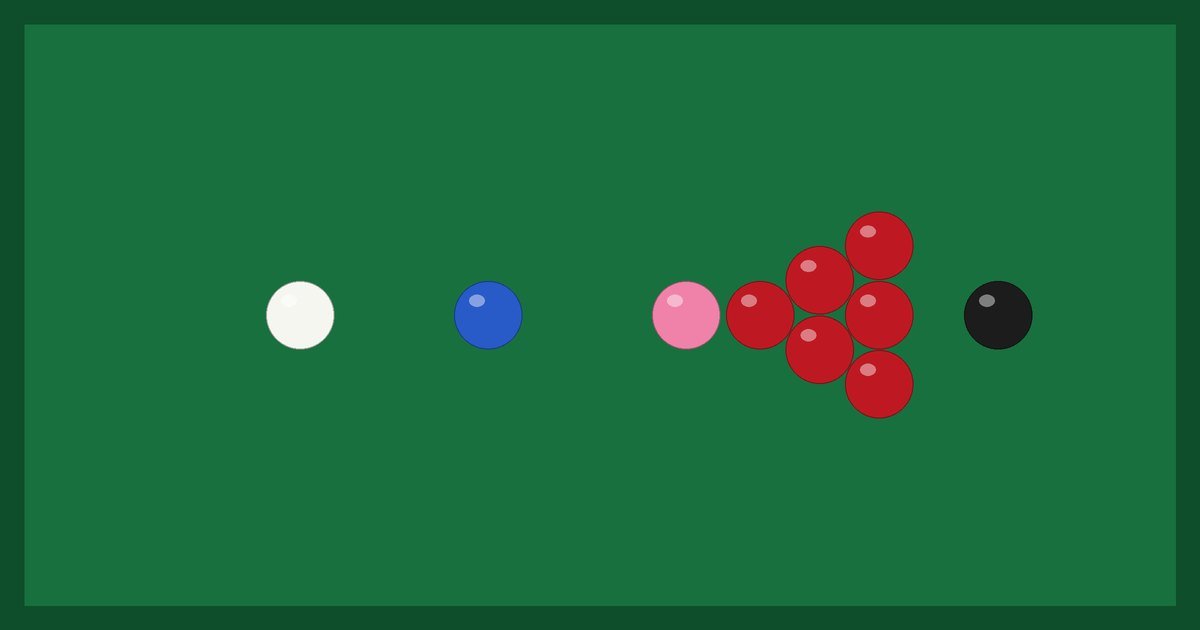
A full frame of snooker, with fifteen reds and six colours, can take a long time, particularly for beginners and on a busy club table. That is why shorter versions of the game exist. The best known is six-red snooker, which keeps every rule and ball value of the full game but uses only six reds. This guide explains how six-red works, how to set it up, how scoring changes, which other quick formats and casual games you can try, and how to adjust your tactics when frames are short.
What is six-red snooker?
Six-red snooker is played on the same table with the same balls, cue and rules as the standard game. The only difference is the number of reds at the start: six instead of fifteen. Players still pot a red, then a colour of their choice, then another red, and so on. When the reds are gone, the six colours are potted in order of value from yellow to black. The player with the most points wins the frame.
The format is popular wherever time is short. Clubs use it for quick matches, coaches use it to give beginners a complete frame without a long wait, and some professional events are played in this format because frames finish faster. Ball values, fouls, free balls, the re-spotted black and every other rule remain the same, so you can learn the full rules in our rules guide and apply them straight away.
How to set up six-red
Place the colours on their usual spots: yellow, green and brown on the baulk line, blue on the centre spot, pink on its spot and black on its spot near the top cushion. Then arrange the six reds in a small triangle of three rows (three at the back, two in the middle and one at the front), with the front red in the same position as the front red of the full pack, close to the pink without touching it. The reds should touch each other. If you have a small triangle rack, use it; otherwise place them by hand, as tightly as you can.
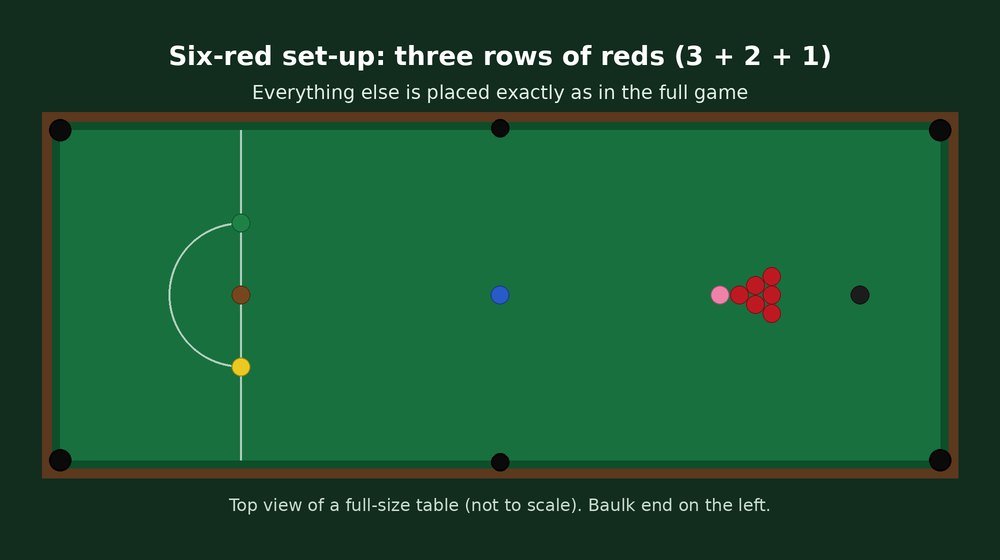
The break-off is the same as in the full game: the first player plays from the D and must hit a red. You can check the position of every spot in our guide to table dimensions and layout.
How scoring changes
Each red is still worth one point and each colour keeps its value, so a red followed by the black is worth eight points. With six reds the arithmetic is straightforward:
| Full game | Six-red | |
|---|---|---|
| Reds on the table | 15 | 6 |
| Points from red + black pairs | 15 × 8 = 120 | 6 × 8 = 48 |
| Points from the final colours | 27 | 27 |
| Maximum break | 147 | 75 |
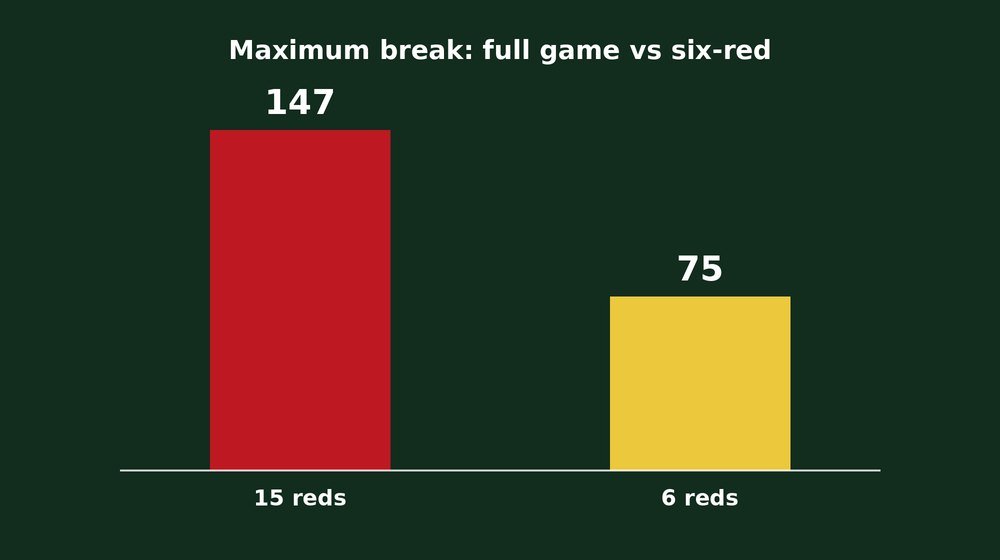
The six colours at the end still add up to 27 points (yellow 2, green 3, brown 4, blue 5, pink 6 and black 7), so they carry a larger share of the total than in the full game. That is why the final colours matter so much in six-red. Our ball points guide shows how to count the points remaining, and the same method works here. Because the total available is smaller, a lead can become decisive more quickly, and a player who needs snookers can find themselves in that position sooner.
How tactics change
- Every chance counts. With fewer reds, there are fewer opportunities to score. Take your first real chance, because you may not get another.
- The pack opens fast. A cluster of six reds is easy to disturb, so there are fewer blockers early on. Learn to plan your break from the first shot, not the fifth.
- Colours decide frames. Be ready to clear the colours accurately. A player who can finish the frame from the yellow is well placed in a tight game.
- Safety still matters. A good safety shot can leave your opponent without a pot. The principles in our safety play guide apply unchanged; you simply have less time to use them.
- Don’t rush. Short frames tempt players to hurry. Keep your normal routine and your technique will hold up.
Other quick formats and casual games
Six-red is not the only way to save time. These ideas are used in clubs, at home and in practice. Many are informal, so agree the rules before you start.
Time-limited frames
Some professional events use frames with a fixed time limit and a shot clock, which forces players to take their shots quickly. A casual version is easy to try: agree a time limit, say fifteen minutes, and the player with the most points at the end wins. Agree beforehand how to treat the balls on the table when the time runs out.
Fewer reds
You can choose any number of reds, such as ten, if you want a game that is shorter than the full frame but longer than six-red. The maximum break changes with the number of reds: it is eight points for every red plus 27 for the colours.
First to a target score
Play a short race, for example the first player to reach 50 points wins, regardless of how many balls remain. This is an easy way to hold a quick contest and works well with beginners.
Reds and blacks
This is better as a practice game than a competitive one. Pot a red, then the black, then replace the black and repeat. It trains the most important routine in break-building: leaving the cue ball in the right area to reach the black after every red.
Clear the colours
Remove the reds and play the colours in order from yellow to black. It is a good drill for position and accuracy, and a full clearance is worth 27 points. See our practice drills guide for more.
Handicap frames
If players differ in ability, a start for the weaker player evens up a short game. Our guide to frames and match formats explains how handicaps work.
Short formats on smaller tables
If you have a smaller table at home, fewer reds also makes sense: the baize is simply less crowded and each frame takes less time. Smaller tables, and sometimes smaller balls, change the feel of the game, and you will find that safety shots and position play need more care in cramped conditions. You can read about sizes in our table dimensions guide.
Rules, etiquette and fair play
Informal formats are fun, but they work best when players agree the rules first: how many reds, how the frame ends, how fouls are handled and what happens with a tie. If you are playing in a league or tournament, always follow the competition’s own rulebook. In every format, call your own fouls and respect your opponent, as discussed in our etiquette guide.
Try it yourself
If you are new to the game, a six-red frame is an excellent way to learn the whole sequence quickly. You will play every stage of a frame, from the break-off to the colours, in much less time than a full game takes, and you will start to recognise patterns in your position play. When you feel confident, move up to the full fifteen reds and see how your break-building develops. If you want to try the red–colour sequence before you visit a table, our free online snooker game is a convenient place to practise, and the beginner’s guide will walk you through the rest.