When people talk about a snooker result such as “10–7” or a “best of 19” final, they are describing frames, the individual games that together make up a match. Understanding how a frame is won, how matches are structured, and how tournaments and rankings are organised helps you follow the sport on television and run your own competitions. This guide explains the frame, common match lengths, how tie-breaks and re-spotted blacks work, how knockout and league formats operate, how professional ranking works, and how to organise a friendly tournament.
What is a frame?
A frame is a single game of snooker, played from the break-off until it is decided. It begins with the balls set up as described in our table layout guide, and it ends when one player wins by scoring more points or when a player concedes. A match is made up of several frames, and the player who wins enough of them wins the match.
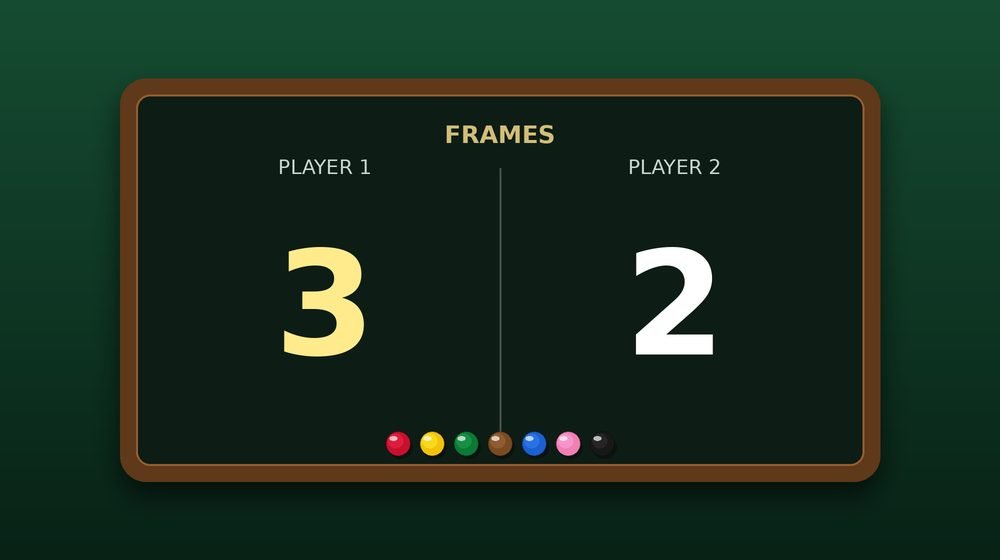
The word “frame” originally referred to the triangular frame used to rack the red balls. It came to mean the whole game, and it is the standard unit of measurement in snooker scoring. A scoreboard that reads “3–2” refers to frames, not to points within a frame, which is a point of confusion for new viewers. The points within a frame are shown separately.
How a frame is won
A frame can end in several ways.
- All balls are potted. When the final black has been potted or the last foul has been scored, the player with the higher score wins.
- A player concedes. If one player is too far behind to catch up, they may concede, usually when snookers are required and there is no realistic chance. In professional matches, this is common practice. The conceding player’s opponent is awarded the frame.
- A tie on the final black. If the scores are level when only the black remains, a tie-break is played (see below).
- A forfeit or rule breach. In some cases, serious misconduct can lead to a frame being awarded to the opponent.
The scoring behind the frame is covered in our guide to ball points, and the full rules of fouls and penalties appear in Snooker Rules Explained. A key idea to remember is that a player who is behind by more than the points remaining needs snookers, which can only come from fouls. When no realistic chance remains, conceding is considered good manners.
“Best of” matches
Snooker matches are described as “best of” an odd number of frames. This means that the winner is the first player to win more than half the frames, so there is never a tie.
| Match format | Frames needed to win | Maximum frames played |
|---|---|---|
| Best of 3 | 2 | 3 |
| Best of 5 | 3 | 5 |
| Best of 7 | 4 | 7 |
| Best of 9 | 5 | 9 |
| Best of 11 | 6 | 11 |
| Best of 19 | 10 | 19 |
| Best of 25 | 13 | 25 |
| Best of 35 | 18 | 35 |
The formula is easy: take the total number of frames, divide by two, and round up. In a best-of-nine match, the first player to win five frames wins, and the match may finish at 5–0, 5–1, 5–2, 5–3 or 5–4. Longer matches reward consistency, because one bad frame has less effect on the outcome. Shorter matches are more volatile and provide more opportunities for upsets.
In early rounds of professional events, matches are usually short, while semi-finals and finals are longer. The final of the world championship, for instance, is played over several days and many frames, which makes it a test of both skill and stamina.
Tied frames and the re-spotted black
Because the black is worth seven points, a frame can occasionally end level on points with only the black left, particularly after a foul or a last-ball fight. When this happens, the black is re-spotted, and the players decide who plays first by a toss. The cue ball is placed in the D, and the first player to pot the black wins the frame. If a player commits a foul, the opponent wins.
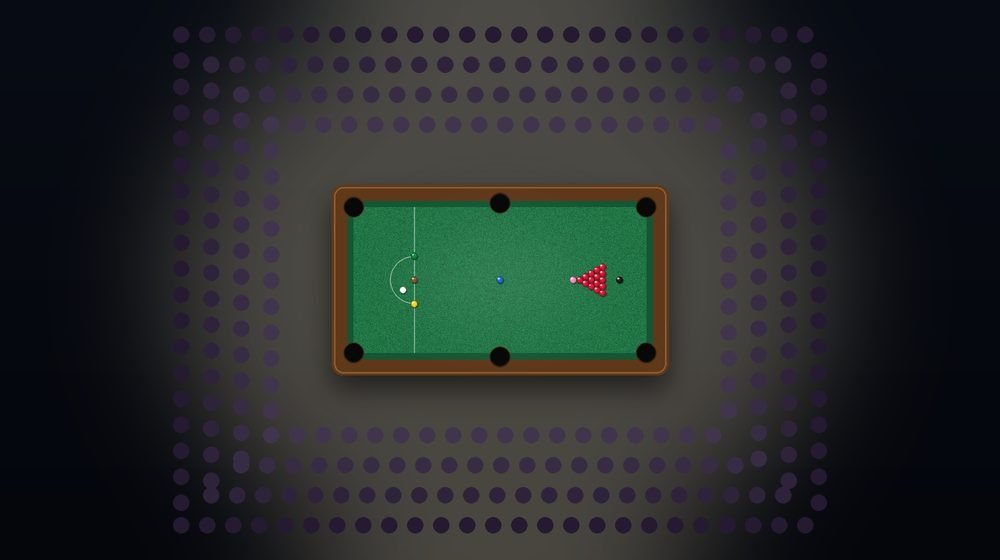
The re-spotted black is one of the most tense moments in the sport. Both players may play a series of safety shots, trying to leave the other with an impossible pot. A mistake of any kind, a miss or a foul, can lose the frame outright. It is a reminder of why the safety and snookering skills described in our guide to snookers and escapes are so valuable.
Sessions and longer matches
Long matches are played in sessions: blocks of frames played in one sitting. A match over several days might have one afternoon session and one evening session each day. Players typically take a break between sessions, and the score simply carries over, so the next session begins from wherever the match stood.
Sessions bring their own tactics. A player who leads at the end of a session has the psychological advantage of a lead, while the trailing player may feel the pressure to recover. Coaches advise players to treat the break as a reset, to take a snack and to refocus. You can read more about that mindset in our mental game guide.
The right to break off is normally decided by a toss or a lag for the first frame, and after that the players alternate, whoever won the previous frame or not.
Knockout tournaments
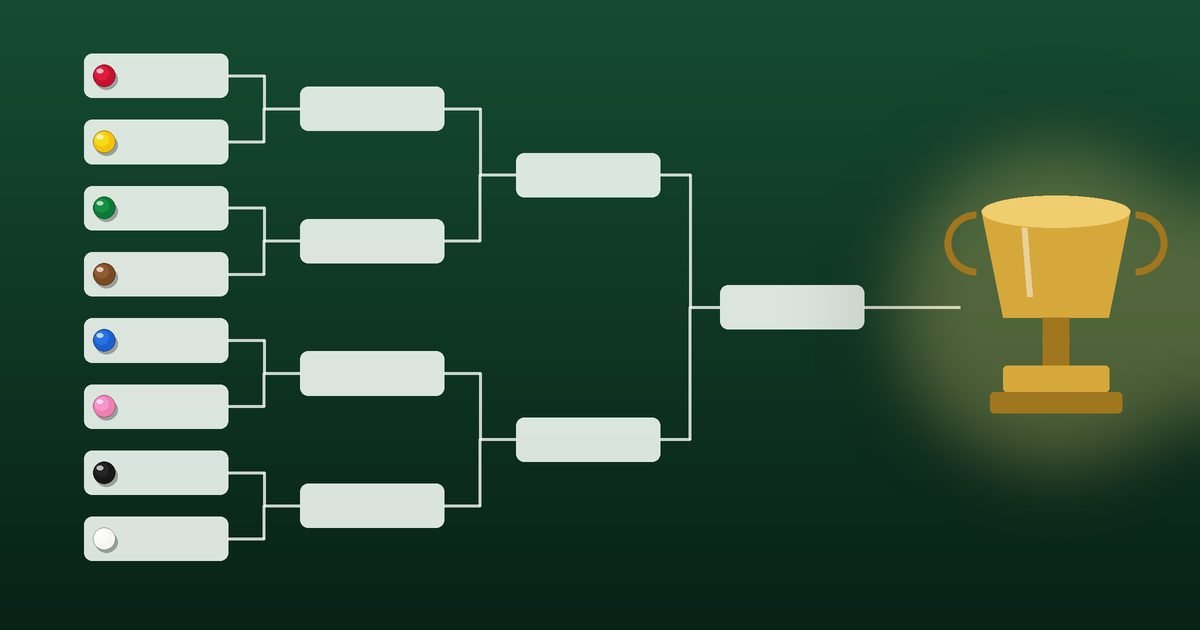
The most common tournament format is the knockout. Players are drawn against one another, the winners advance and the losers are eliminated, until only one remains. A knockout of sixteen players has four rounds: the last sixteen, quarter-finals, semi-finals and final. Larger fields have more rounds, and in the first round some players may receive a bye if the number of entrants is not a power of two.
Seeding is used to avoid the top players meeting early. The highest-ranked players are placed in separate parts of the draw, so that they can meet only in later rounds. The remaining players are drawn at random. This is how most professional events are organised, and it is easy to run in a club, with a printed draw sheet and a schedule of matches.
The strength of knockouts is their drama, because every match matters. The weakness is that a single bad day can end a player’s event, which is why league formats exist.
League and group formats
In a league, every player or team plays the others, usually in a round-robin pattern, and the final table is decided by points. A win typically earns two or three points, and a draw, if allowed, earns one. League formats are common in local snooker clubs, where teams of players compete over a season, and they give everyone a good number of matches.
Some tournaments combine both ideas: a group stage, in which players are divided into groups and play each other, followed by a knockout between the top finishers. This gives players more than one chance to qualify, and it is used in several major events. Tie-breaks in group tables are often decided by frame difference, the difference between frames won and lost, or by the result of the match between the tied players.
Professional tour and rankings
The professional game is organised as a tour of tournaments across the season, with players earning ranking points and prize money based on how far they progress. Rankings are based on prize money earned over a rolling period, usually two seasons, and they determine seedings and entry to some events. The top players in the rankings receive automatic places in the most important tournaments, while others must qualify.
The most prestigious events are the Triple Crown tournaments, the World Championship, the UK Championship and the Masters. The World Championship, held at the Crucible Theatre in Sheffield, is the sport’s pinnacle. Match lengths grow as the event progresses, and the final is a marathon. For a more general account of how the sport evolved to this point, see our history of snooker.
The details of rankings and qualifying change from season to season, so if you follow the pro game, check the governing body’s current rules for the latest information.
Handicaps
A handicap system lets players of different abilities enjoy a fair match. The stronger player gives the weaker one a head start, in points, at the beginning of each frame. A player might receive, say, 20 points, or might give away a number of points to the opponent. Handicaps can also be set by frames, where the weaker player begins each match with one or two frames in hand.
The aim of a handicap is to make the result uncertain, so that both players have a real chance of winning. Handicaps are widely used in clubs and in friendly competitions. They are adjusted over time as players’ abilities change, so that the system remains fair.
Running a friendly tournament
If you would like to organise a competition with friends or at a club, a few simple steps will help.
- Decide the format. For up to eight players, a round-robin league works well. For larger groups, a knockout is simpler.
- Choose the match length. Best of three or five frames is enough for early rounds, with longer matches for the final.
- Agree the rules. Make sure everyone follows the same set, such as the rules explained in our rules guide, and decide whether to use a handicap.
- Make a draw sheet. Write the names on a chart and update it as the matches are played.
- Set deadlines. Give players dates by which each round must be played, to keep the event moving.
- Appoint a referee or marker for the final, if possible.
- Celebrate. A small trophy or a certificate makes the winner feel special.
Before the event, encourage players to practise and review the etiquette guide so that everyone knows what is expected. If you need a quick way to practise, our free online snooker table is always available, and you can use it to warm up before a match.