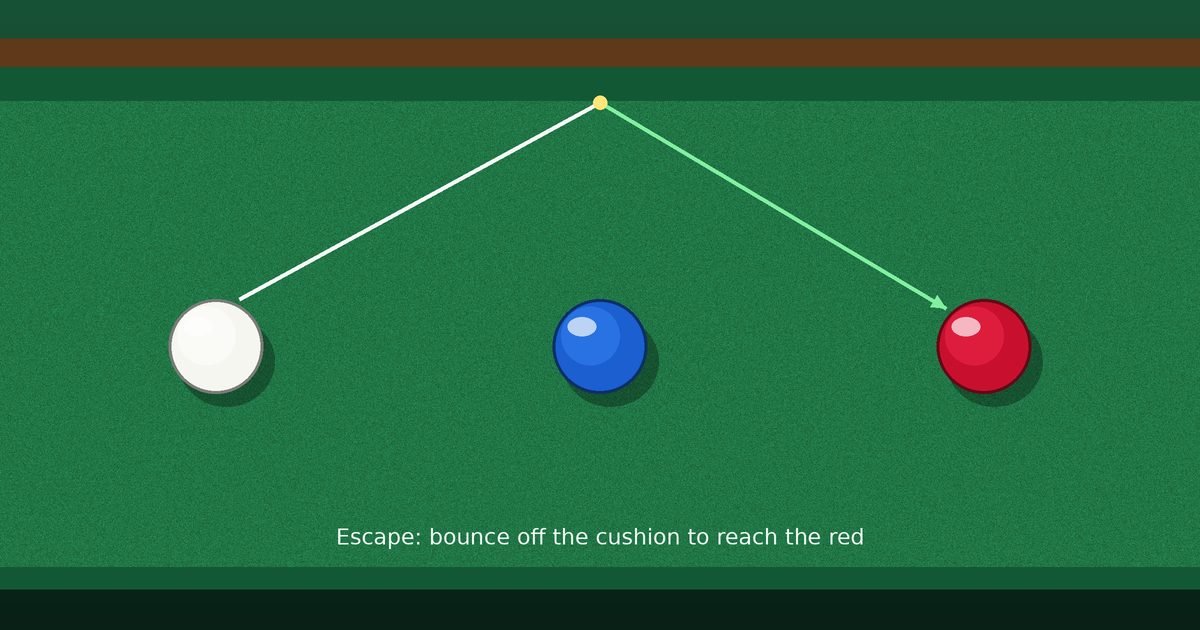
“Snookered” is one of the few snooker terms that has escaped into everyday English, where it means being stuck with no good way out. In the game it has a precise meaning, and the tactics of laying snookers and escaping from them make up a large share of match play. This guide explains exactly what a snooker is, how to create one, how to escape from one, what the rules say about a missed escape, and some practical advice for both players.
What is a snooker?
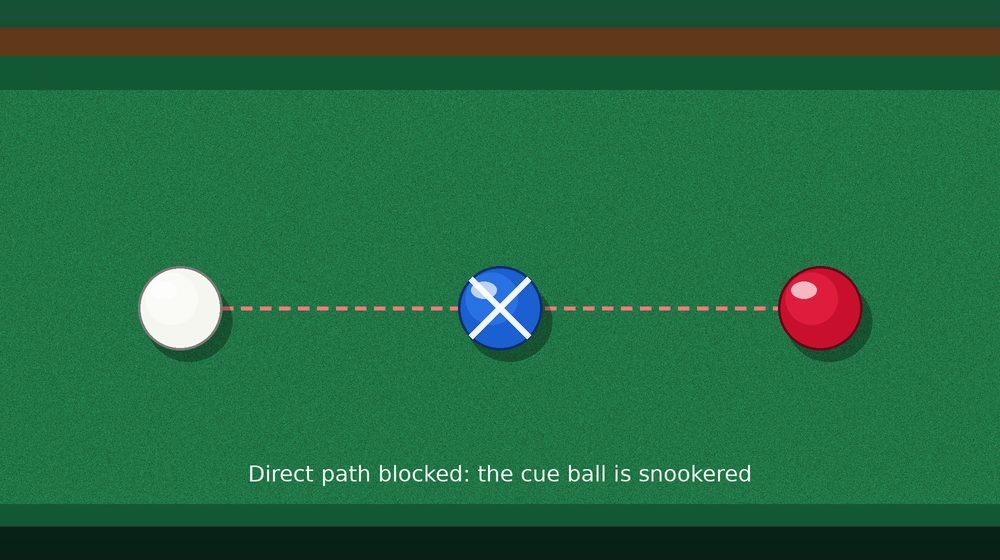
A player is snookered when the cue ball cannot travel in a straight line to touch both edges of any ball that is “on”, because another ball is in the way. A ball is on when it is one the player is allowed to hit first. At the start of a turn, with reds on the table, every red is on. After a red is potted, any colour is on. When only the colours remain, the lowest-valued colour is on.
In other words, if a ball that is not on blocks the direct path to every ball that is on, you are snookered. If you can still see even a small part of a ball that is on, the position is not a snooker in the strict sense, although the shot may be very difficult.
Many beginners confuse a snooker with a simple awkward position. A tricky pot is not a snooker. A snooker concerns blocked paths and the need to play around an obstruction. The word has been used since the game’s earliest days, and it gives the sport its name.
Why snookers matter
When you are snookered, you cannot play a normal shot. You must try to hit the ball on by sending the cue ball off one or more cushions, which is hard to do with accuracy. If you fail, you commit a foul, and your opponent receives at least four points, as well as the option to make you play again.
That makes snookers a powerful weapon. They allow a player to score points without potting, because fouls give points. They also let you take control of a frame when you are behind. A big lead is not always safe if the opponent can leave you snookered at the end.
For these reasons, understanding snookers is a core part of match tactics. Our guide to safety play shows how snookers fit into the wider plan, and Snooker Rules Explained lists the penalty values for fouls.
How to lay a snooker
To leave your opponent snookered, place the cue ball so that a ball not on is in the way of all the balls that are on. The most common ways are:
- Behind a colour. After you have potted a red, you can leave the cue ball behind a colour so that the next red is hidden.
- Behind the black. The black near the top cushion is often used to hide the last red.
- Behind a red. When the pack has opened, you can sometimes hide the cue ball behind a single red.
- Using the cushions. The cue ball can finish against a cushion with a ball in the way.
When laying a snooker, pace is vital. The cue ball must stop in exactly the right place, and a few inches too far can leave your opponent a straight shot. Practise soft shots and thin contacts. The ideal snooker leaves the cue ball tight behind the blocking ball, with the escape route difficult.
Think about the consequences of your own shot. A snooker is only a success if your opponent cannot hit the ball on and fails. Even good players leave a “soft” snooker in which a simple one-cushion shot allows an escape.
How to escape a snooker
Escaping means hitting a ball that is on, despite the obstruction. The only way is to play off one or more cushions, so that the cue ball can curve around the blocking ball. A good escape is much like a geometry problem. A few principles help.
- Find the angle. Look at the table and imagine the cue ball bouncing off the cushion. A mirror image of the table can help: reflect the target ball across the cushion and aim at the reflection.
- Choose the cushion. Pick the cushion that gives the widest angle and the longest clear path.
- Control the pace. A fast shot is harder to control. A medium pace is usually best, giving you time to hit the ball and not run into a pocket.
- Consider the aftermath. Even when you escape, think about where the cue ball will end up. A glancing contact that leaves a clear pot for your opponent is almost as bad as missing.
- Use a little side if needed. Side spin changes how the cue ball leaves the cushion, which can help with a tricky angle. Use it sparingly.
A simple escape usually involves a single cushion and takes a few seconds to work out. Harder ones require two or three cushions and can be very difficult, particularly when the target is a single red at the far end of the table.
Kicking at a ball
A shot where the cue ball hits a cushion before reaching the ball on is often called “kicking”. A well-judged kick strikes the ball on with a thin contact and leaves the cue ball somewhere safe. Many professionals practise kicking shots because they come up in nearly every match.
Cushion rebounds change with pace, spin and the state of the cloth, so the same aiming point does not always give the same result. Experience helps you find the pace that suits your table, and a medium pace is usually the most predictable.
When you take a long kick, keep your head still and look at the point on the cushion, not the ball on. It is the contact on the cushion that decides the shot.
Fouls and the miss rule
If you are snookered and fail to hit the ball on, it is a foul. The standard penalty is four points, though it may be higher if the ball on or the ball you hit first has a higher value, so the penalty can be as high as seven. Your opponent can also choose to play from the position you leave, or to ask you to play again from where the balls were before your shot.
That last option is the “foul and a miss” rule. If the referee judges that you did not make a good attempt to hit the ball on, they declare a miss, and your opponent can ask for the balls to be replaced. It aims to stop players from deliberately missing, which would make snookers pointless. A referee will consider the circumstances: how difficult the shot was, how close you came and whether you appeared to try. A good attempt that just fails is not a miss, but a half-hearted shot with no sign of effort may be penalised. The rule is covered in more detail in our rules guide.
The free ball
A free ball is awarded when your opponent commits a foul and leaves you snookered, so that the cue ball cannot hit both edges of any ball that is on. You may then nominate any ball on the table as though it were the ball on. If you hit it first, you play on as normal. If you pot it, you score the value of the ball that was really on, usually one point for a red, and the nominated ball is put back on the table. It is a way of making sure that a player is not punished twice for a position they did not create.
Free balls are an important part of tactics because they let you switch from defence to attack. Treat them as a chance to start a break, but check where the cue ball will finish before you commit.
Snookers required
Near the end of a frame, a player may need more points than are left on the table. The player behind then “needs snookers”: they must force their opponent to foul to earn enough extra points to win. In that case, the player behind can only win if the leader makes mistakes, usually escaping from snookers badly.
When you are behind, try to leave the cue ball behind the last colours or reds. Persistence is vital: even if the scoreboard looks hopeless, a single mistake from your opponent can open the way. When you are ahead, keep calm and be careful with escape shots. Many frames are lost by players who relax too soon. To work out whether snookers are required, count the points left on the table; our guide to ball points shows you how.
Practising snookers and escapes
A basic drill for laying snookers is to place one red and one colour on the table and try to leave the cue ball behind the colour after playing from the baulk end. Repeat the drill until you can do it consistently. For escapes, put the cue ball behind a colour and the red at the far end, then practise kicks from different cushions. Mark where the cue ball hits the cushion on each attempt, so you learn the correct aiming point. Many more exercises appear in our practice drills guide.
Learning to snooker and escape well will give you a significant edge in matches. It teaches you to think about the table as a whole, to control the cue ball precisely and to keep your cool under pressure.