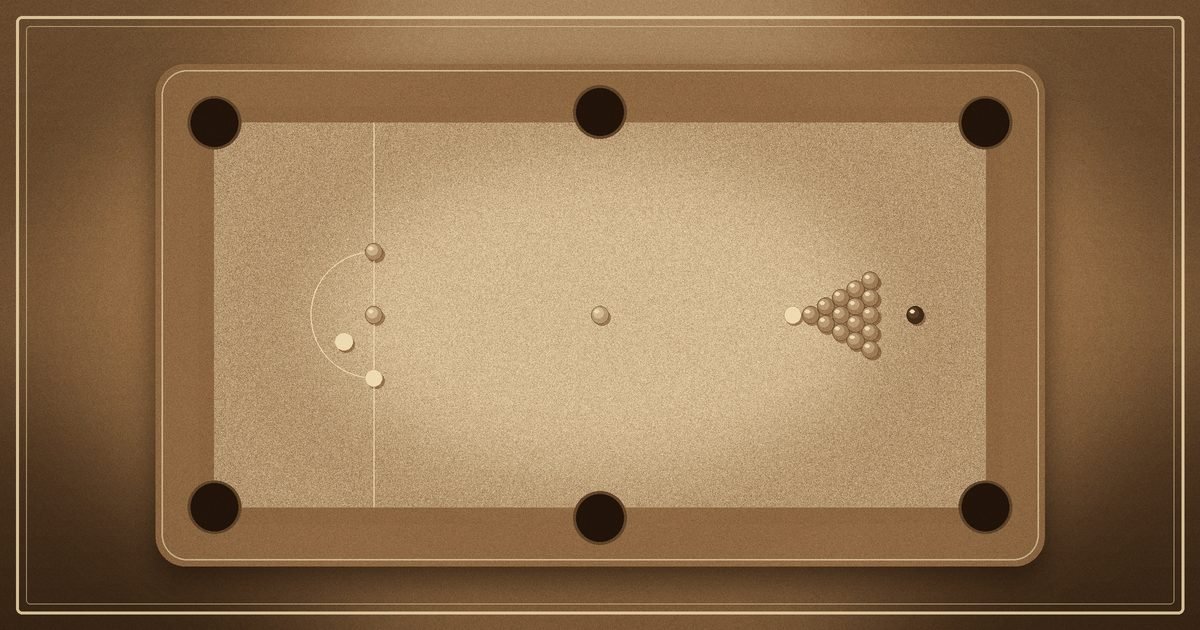
Snooker is a young sport by the standards of cue games. Billiards in various forms goes back centuries, but snooker itself appeared only in the second half of the nineteenth century, and it became a global television spectacle in the twentieth. This guide traces how the game began, where its odd name comes from, how it grew from an army pastime into a professional sport, and how it is played and watched around the world today.
Before snooker: billiards and pool
Games played with sticks and balls on a table have existed in Europe since at least the fifteenth century. Early versions were played on lawns, then moved indoors onto tables with raised edges. By the nineteenth century, billiards had become a fashionable pastime in Britain, played on a large table with three balls and scored by cannons (hitting both of the other balls) and by pocketing, known as hazards. For more on how that game compares, see our guide to snooker vs. English billiards.
Alongside billiards, several simpler pocket games were played. One of them, pyramid or pyramids, was played with fifteen red balls arranged in a triangle and a single white cue ball. Another, black pool, used a black ball. These games were quick, easy to learn and popular in bars and clubs. They are the direct ancestors of the game we now call snooker.
The invention of snooker
The standard account of the game’s origin is that it was invented in 1875 in India, at the British army garrison in Jubbulpore, now Jabalpur. An officer, Neville Chamberlain, is widely credited with combining pyramids with black pool. According to the story, he added coloured balls to the table so that players would pot reds and then colours, giving the game a new layer of strategy. The details of that evening are told and retold, and some historians treat parts of the story with caution, but it is generally accepted that the game took shape among British officers in India in the 1870s.
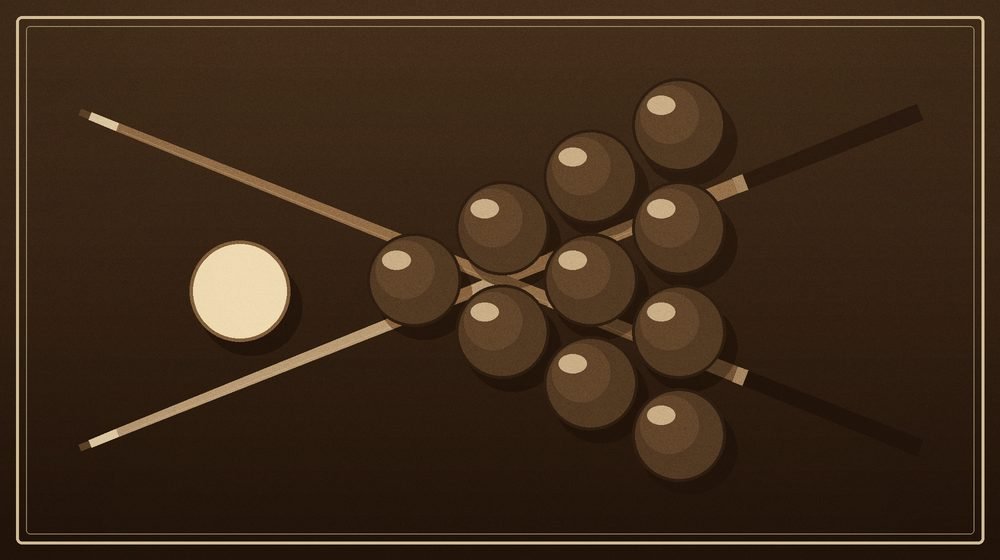
What made the new game different was the red-and-colour structure. In pyramid, all balls were equal. In snooker, the player had to choose between low-value reds and higher-value colours, so tactics and planning mattered more. The colours were replaced on their spots after being potted until the reds had gone, which allowed the same valuable ball to be used again and again. That feature makes high breaks possible, and it is still the core of the game. Our guide to snooker ball points shows how that structure builds scores.
Where the name comes from
The word “snooker” has a colourful history. It was military slang for a newly trained or first-year cadet, a person without experience. According to the common story, a player missed a shot and Chamberlain called him “a regular snooker”, meaning that he was a novice at the game. The label stuck, the players decided that everyone was a snooker when they were learning the game, and the name transferred to the sport itself.
The word later took on a second meaning in the game: to snooker someone is to leave them with no clear shot, which is the sense we use in everyday language when we say someone is “snookered”. The tactics behind that meaning are explained in our guide to snookers and escapes.
The spread across Britain
Officers brought the game back to Britain, and by the end of the nineteenth century, it was being played in military messes, private houses and billiard halls. It remained a secondary game for a while, a pastime that billiards players enjoyed when the main table was not in use. Billiards, with its strong professional circuit, was seen as the more serious sport.

Gradually, the balance shifted. Snooker was cheaper to play than billiards on a large scale, because the rules allowed many people to enjoy a frame without lengthy matches. It also lent itself to a social setting. Billiard halls in industrial towns and working men’s clubs installed tables, and the game became a staple of leisure. As more people played, the standard of play rose, and the idea of a formal, professional championship arose.
The World Championship
The first official World Snooker Championship took place in 1927, organised by the professional players Joe Davis and Bill Camkin. Davis, an English player, won the first title and dominated the sport for years afterwards. He was a pioneer of break-building and positional play, and many of the techniques he developed are still taught. The championship, held in several venues in its early years, was a modest event for much of its first decades, with small audiences.
Interest in snooker declined in the years after the Second World War, partly because of the dominance of a few players and partly because of changes in leisure habits. For a time the sport survived mainly as a club game. It needed a new audience and a new medium.
Colour television and the boom
That medium turned out to be television. The coloured balls of snooker were almost made for colour broadcasting, which began to spread in Britain in the late 1960s. A BBC programme called Pot Black, launched in 1969, used short, one-frame matches played by leading professionals. It was a surprise hit, and it brought snooker into millions of homes.
In the late 1970s, the World Championship moved to the Crucible Theatre in Sheffield, a venue that has hosted the tournament ever since. The intimate theatre created an atmosphere of tension and drama, and the sport gained a new generation of personalities. Players such as Ray Reardon, Alex Higgins and Steve Davis became household names. In the 1980s, television audiences for snooker reached huge numbers, with major matches drawing audiences of many millions, and the sport entered a golden age. The late 1980s and 1990s saw Stephen Hendry win seven world titles in the modern era, a record that has stood for decades.
The modern game
Today, snooker is a professional sport with a ranking system, an international tour and a calendar of events, including the three most prestigious events known as the Triple Crown: the World Championship, the UK Championship and the Masters. Prize money has grown, and top players earn a good living. The game has also become faster and more athletic. Break-building standards are higher than ever, and centuries, breaks of 100 or more, are common in tournaments.
The 147, the maximum break, was once an extraordinary rarity but is now achieved several times a season on the professional circuit. Technology has also changed the experience: players use sophisticated tables and cloths, referees use video review for disputed decisions, and fans follow events online and on streaming services. The rules, however, have changed very little in principle. If you are curious about the current rules, read Snooker Rules Explained.
Snooker around the world
Although snooker began in India and flourished in Britain, it has become a global sport. Ireland, Australia, Canada and South Africa have long traditions. In recent decades, the game has exploded in popularity in China, where millions play and where several of the largest tournaments are now held. Players from Hong Kong, Thailand, Pakistan, India and across Europe have reached the top of the rankings.
Amateur snooker has its own world governing body and international championships. Many countries run national leagues and youth programmes, and the game is played in clubs, schools and homes. Online games, including the one on this website, have helped introduce the sport to people who have never held a cue.
Why the history matters
Knowing where snooker comes from helps you understand why it looks the way it does. The red-and-colour pattern, the small pockets, the baulk line and the D all grew from earlier games. The emphasis on tactics comes from the military origins, where the point was a contest of skill and nerve. The long, silent concentration of the modern professional is a product of the television era.
If you want to dive into the practical side of the game, begin with our complete beginner’s guide, learn the layout in our guide to table dimensions and then try a frame on our free online table. The history of the sport is still being written, and every player who picks up a cue becomes part of it.