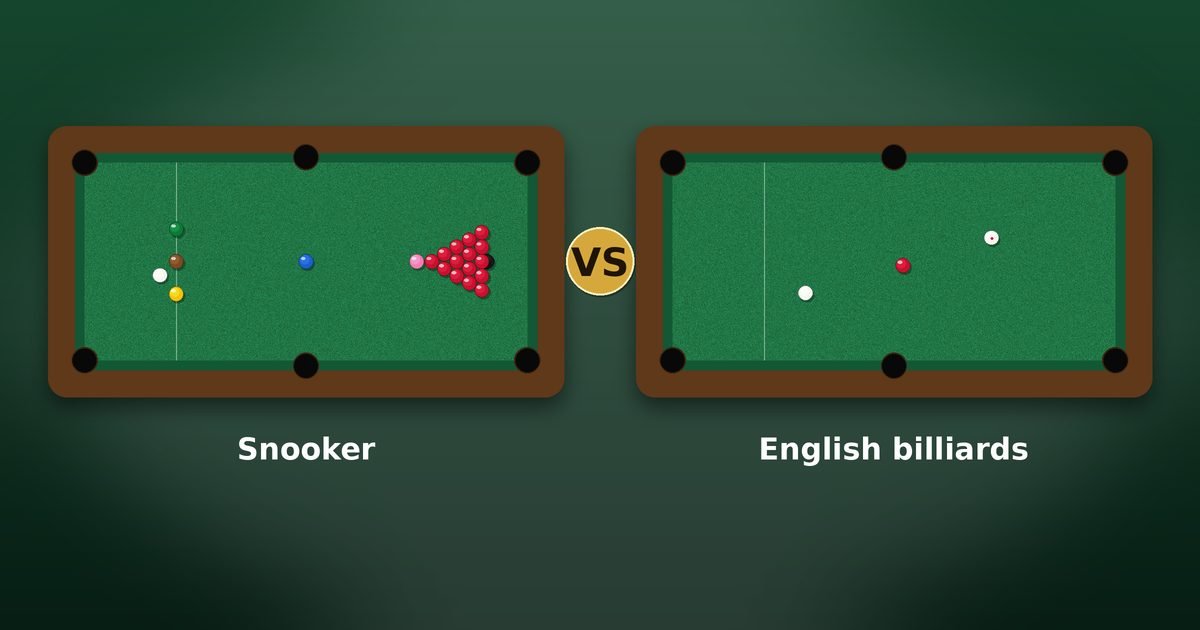
Snooker grew out of billiards, and the two games still share a table, a cue and a good deal of history. Yet a player who is strong at one can feel lost at the other. English billiards, the older game, is played with only three balls and is scored in a completely different way. This guide explains how English billiards works, how it differs from snooker in rules, scoring and tactics, how the two relate to American pool and carom billiards, and why snooker overtook its parent game in popularity.
What is English billiards?
English billiards is a cue sport played on the same large table as snooker, using just three balls: a white, a white with a spot (or a yellow, depending on the set) and a red. Each player has their own cue ball, one plain and one marked, and the red is shared. The aim is to score points by making a combination of strokes, and the first player to reach an agreed total, or the player with the most points when the time runs out, wins.
In the nineteenth century, billiards was the leading cue game in Britain, with professional champions and large crowds. The rules were refined over many years, and the game was officially codified in the late nineteenth century. Snooker began as a side game that players enjoyed when the billiards table was free, as we describe in our history of snooker. Some of the early snooker champions were also billiards champions, and the two sports were closely linked for decades.
The table and equipment
The table is the same size as a full-size snooker table and typically has the same six pockets, so a club can host both games. The cloth, cushions and cues are also the same or very similar. The differences are in the balls and the markings.
- Balls: three, rather than twenty-two. They are the same size as snooker balls.
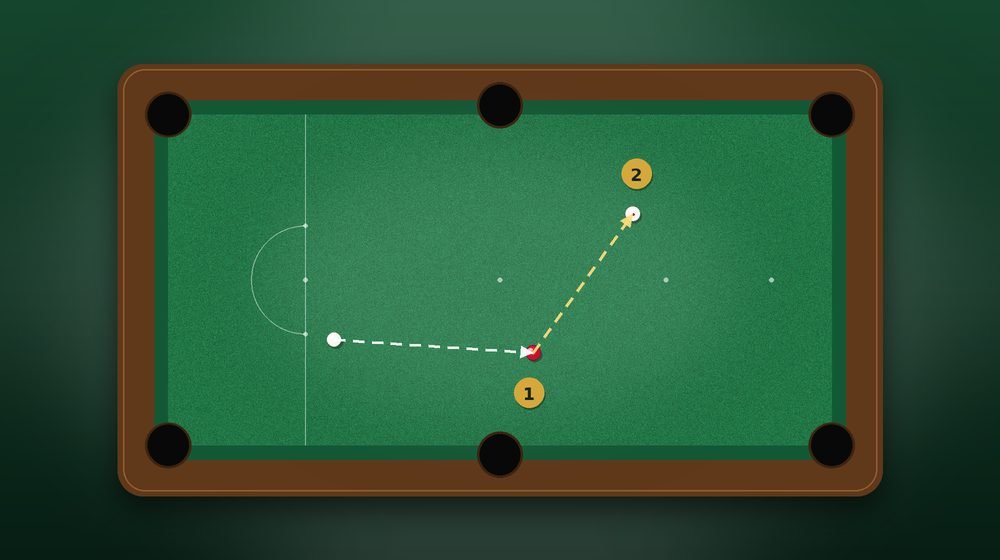
- Markings: the baulk line and the D are used, and there are additional spots. A billiard spot, a pyramid spot and a centre spot are marked on the cloth, and the red is placed on the billiard spot at the start of the game.
- Cue: the same cue is used, but many billiards players like a slightly heavier one.
- Rest: the same rests and spiders are used for out-of-reach shots.
Because the table and equipment are the same, many snooker clubs also have a billiards scoreboard, and some players enjoy switching between games. To learn more about the table, see our guide to table dimensions and layout.
How billiards is scored
There are three ways to score in English billiards, each worth a different number of points.
| Stroke | What happens | Points |
|---|---|---|
| Cannon | The cue ball hits both of the other balls in one shot | 2 |
| Pot (red) | The red ball is pocketed | 3 |
| Pot (opponent’s ball) | The other player’s cue ball is pocketed | 2 |
| In-off (white) | The cue ball goes into a pocket after hitting the opponent’s ball | 2 |
| In-off (red) | The cue ball goes into a pocket after hitting the red | 3 |
These values are the standard figures in the traditional game. A single shot can score in more than one way, so a stroke that pots the red and also makes a cannon, for example, earns the combined total. Skilled players build up long runs, called breaks, by repeating the same patterns of shots, and breaks in the thousands have been recorded at the highest level.
There is no sequence of reds and colours as in snooker, and there is no concept of potting a specific ball after another. The scoring is driven by repeated contact between balls, and by controlling all three balls at once.
The main scoring strokes
Billiards has its own vocabulary of strokes.
- The cannon is a shot in which the cue ball strikes both other balls. It is the basic building block of a break.
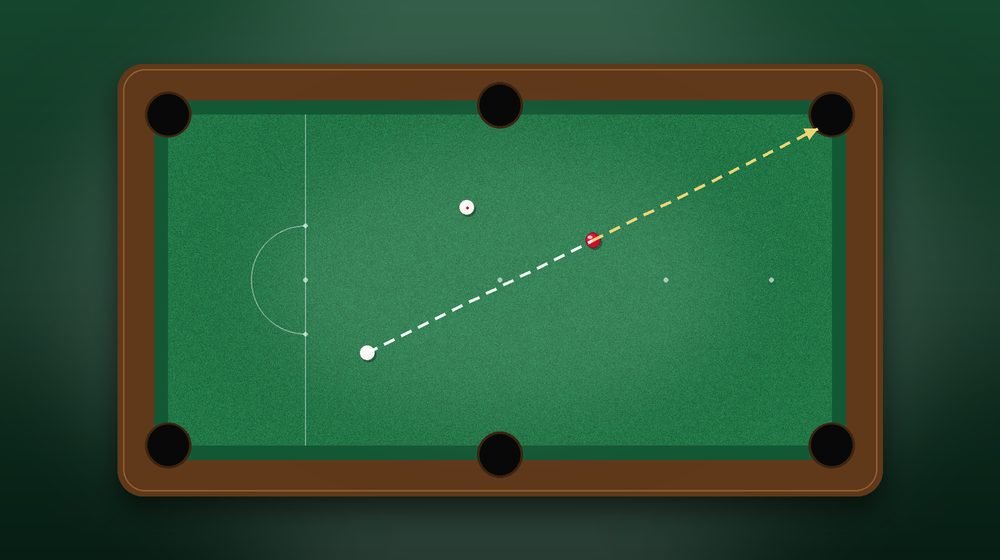
- The hazard is a pot of either the red or the opponent’s ball (a “winning hazard”), or the cue ball going into a pocket after striking another ball (a “losing hazard”, or in-off).
- The close cannon is a technique in which the three balls are kept close together near the cushion, and the player gradually nudges them around to score repeatedly.
- The nursery cannon is a similar shot that keeps the balls together in a small group, requiring very delicate control of speed.
- The pot-red and in-off sequence uses the red and a cue ball in turn, scoring three points each time.
To keep play interesting and to stop one player from scoring endlessly, the rules limit certain repetitive strokes. For example, there are restrictions on how many times a player may play the same kind of hazard or cannon in a single break. These rules show how strongly the game relies on skill with small, controlled movements, and they help to explain why top players describe billiards as a very different test from snooker.
Side-by-side comparison
| Feature | Snooker | English billiards |
|---|---|---|
| Table | 12 × 6 ft, six pockets | Same table, six pockets |
| Number of balls | 22 | 3 |
| Cue balls | One shared white | One each (white and spotted) |
| Scoring | Points for each ball potted, in sequence | Points for cannons, pots and in-offs |
| Highest-value scoring action | Potting the black (7) | Potting the red or going in-off it (3) |
| Typical match | Best of an odd number of frames | Timed or points-based |
| Maximum break | 147 | No fixed maximum |
| Main skill | Potting and positioning for a sequence | Controlling three balls through repeated contact |
| Safety play | Central to match play | Present but less dominant |
The differences illustrate how two games on the same table can feel unlike each other. Snooker is about sequence: pot a red, then a colour, over and over. Billiards is about rhythm and control: keeping the balls where you want them as you score again and again.
Tactics: two very different games
In snooker, tactics revolve around safety play, snookers and the choice between attack and defence. You can see a full discussion in our guides to safety play and snookers and escapes. In billiards, tactics are different. Because the player who scores keeps the table, the aim is to build a break by controlling the balls, and defence is about leaving the three balls in an awkward arrangement for the opponent, often by sending the red into baulk or leaving the cue ball in a difficult position.
Billiards also places a higher premium on accuracy of speed. A cannon requires the cue ball to hit two balls in a row, often at a specific pace, so players spend years learning to judge distance and weight. Many experienced players say that billiards helped them to control the cue ball in snooker, and this is one reason some training programmes include it.
In snooker, by contrast, you must choose your shots from many possible balls, and the main challenge is deciding what to play and keeping a clear head over a long frame. Our mental game guide looks at that side of the sport.
Other billiards games
The word “billiards” covers a family of cue games, which can cause confusion. In British usage it often means English billiards. In American usage it can refer to any of the pocket games, including pool, though the word is also used for carom games.
- Carom billiards is played on a table with no pockets, with three balls. Players score by making the cue ball hit both other balls. It is popular in Europe, Asia and parts of South America.
- Pool games such as eight-ball and nine-ball are played on smaller pocket tables. They are described in our guide to snooker vs. pool.
- Straight pool is a pocket game in which any ball may be called and potted for one point each.
- Russian pyramid and similar games are played on large pocket tables with bigger pockets and different rules.
All these games share the principle of striking a ball with a cue, but their rules and skills differ widely. If you enjoy one, you will often find the others interesting.
Why snooker became more popular
For much of the late nineteenth and early twentieth centuries, billiards was the more prestigious game. Several things changed that.
- Spectator appeal. A frame of snooker is a clear contest with a visible score and a dramatic ending, especially when it comes down to the last ball. Billiards breaks can last for a long time and are harder for a casual viewer to follow.
- Colour television. The coloured balls were ideal for broadcasting, and televised tournaments in the 1970s and 1980s turned snooker into a mass-audience sport.
- Accessibility. Snooker’s rules are easy to grasp: pot red, pot colour, repeat. Beginners can enjoy it from the first frame, whereas billiards scoring can take longer to understand.
- Match format. Frames create natural drama, with momentum swings and comebacks. Billiards matches, often decided on points or time, are more gradual.
Billiards has not disappeared. It has its own world championships, a dedicated community and a loyal following. But snooker has become the main cue sport in Britain and much of the Commonwealth, and it has captured growing audiences in Asia.
Which should you try?
If you already play snooker, trying billiards can be a refreshing change. It sharpens your touch, improves your cue-ball control and shows you the table in a different way. If you are new to cue sports, snooker is probably the best place to begin, because it is widely played and its rules are easy to learn. Start with our complete beginner’s guide, and when you are comfortable, ask at a local club whether they have a billiards table and anyone willing to show you the basics. You may find that a game you thought you knew has another side.