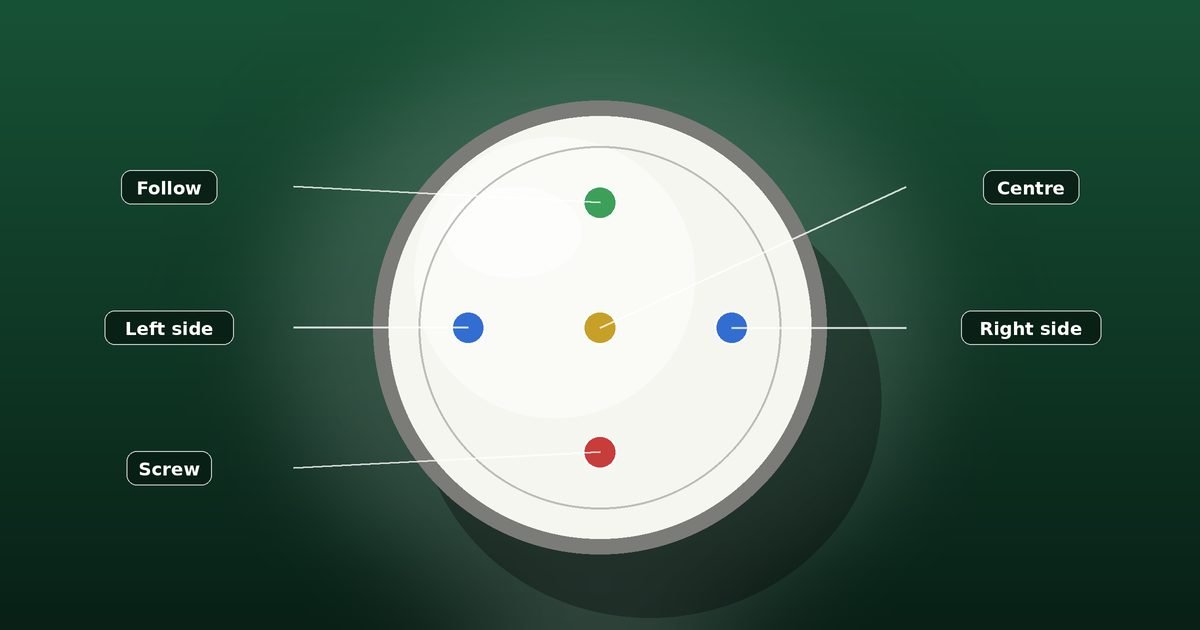
The cue ball does not have to travel in a straight line after it hits an object ball. By striking it at different points, you can make it stop, roll on, draw back, or curve towards a cushion. This control, usually called spin or cue-ball action, is the secret behind almost every long break. This guide explains the three basic actions (stun, follow and screw), how side spin works, how to aim, how hard to hit, and how to practise each safely.
Where you hit the cue ball
Imagine the cue ball as a clock face, or as a target with a bullseye in the centre. Where the tip touches the ball decides what kind of spin the ball receives.
- Centre: a plain roll with no extra spin. The ball slides at first, then starts rolling.
- Above centre: topspin, or follow. The ball keeps rolling forward after it hits another ball.
- Below centre: backspin, or screw. The ball tries to travel backwards.
- Left or right of centre: side spin, sometimes called “side” or “English”. The ball turns around its vertical axis and changes direction when it hits a cushion.
The tip must always strike within a small area of the ball, roughly in a circle in the middle about half its width. Hitting too close to the edge causes a miscue, where the tip slips off the ball. A well-chalked tip and a smooth, straight stroke prevent this. If you need guidance on the cue itself, our cue guide covers tips and chalk.
Stun: the foundation
A stun shot is played when the cue ball is hit slightly below centre, with just enough backspin to cancel its forward roll at the moment of contact. When the cue ball strikes the object ball head-on, it stops dead. When it strikes at an angle, it leaves the contact at a right angle to the direction the object ball travels, which is a useful rule to remember.
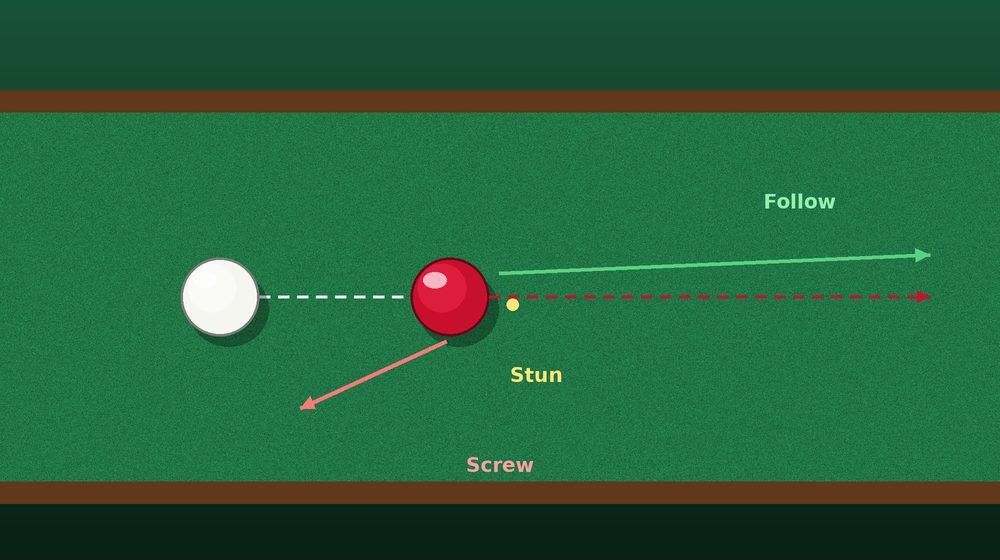
That 90-degree rule is among the most important facts in positional play. Because a stun-shot cue ball leaves at a right angle to the object ball’s path, you can predict exactly where it will go. If you are potting a ball into a corner pocket and the cue ball is going to move at 90 degrees to that line, you can decide quickly whether it will end up in a useful place.
To play a stun shot:
- Aim the tip about a half to one tip-width below the centre.
- Use a smooth, medium stroke with a good follow-through.
- Keep the cue level, to avoid imparting unwanted swerve.
A stun shot is not fixed to a single speed. The firmness of the shot and the distance between the cue ball and the object ball decide how much of the cue ball’s natural roll remains. Experiment on a clean table, and pay attention to what happens at various distances.
Follow (topspin)
Follow is the opposite of screw. You strike the cue ball above its centre, which gives it forward rotation. After contact with the object ball, the cue ball continues forward, following the object ball along its path. It is used to move the cue ball up the table or to bring it forward off a cushion.
- Use for straight pots. A little follow makes the cue ball creep on after a straight pot, so it stays close to the pocket.
- Use for angled pots. At an angle, follow makes the cue ball bend forward after contact, curving it away from the 90-degree path of a stun shot.
- Use to send the cue ball around the table. After a red is potted, follow can send the cue ball towards the black or the cushion for the next shot.
A key point is that follow is easier to apply at a gentle pace than screw, but also easier to apply too much. Excess follow can send the cue ball into the pocket behind the object ball, which counts as a foul called an in-off. If you play a straight pot with heavy topspin, check where the cue ball will end up.
Screw (backspin)
Screw is striking below centre with enough power that the cue ball spins backwards after contact. On a straight pot it will return towards you along the line of the shot. On an angled pot it will curve back, away from the straight line.
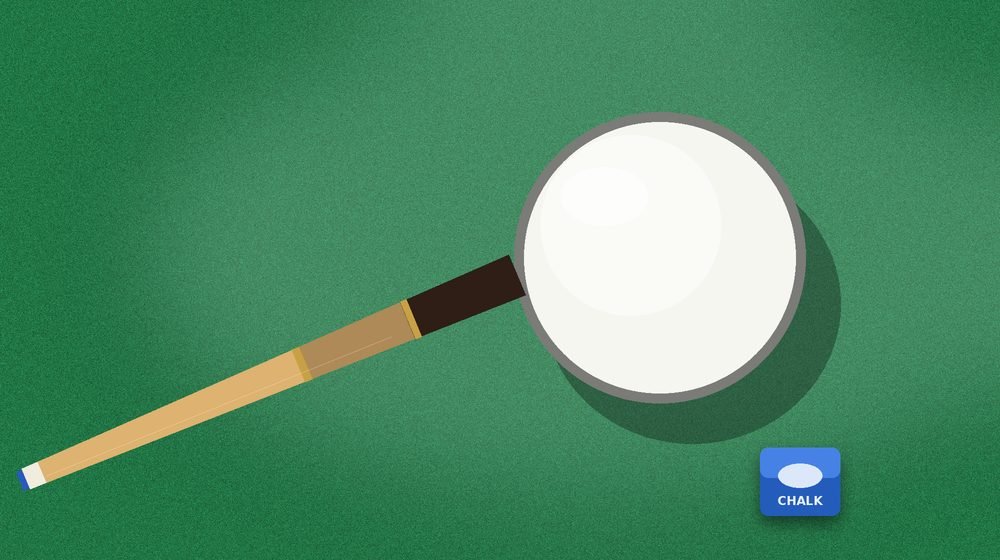
Screw is a more advanced shot than stun or follow. It requires:
- A level cue and a solid bridge, because any rise of the butt will cause a miscue.
- A long, smooth follow-through, which lets the tip stay in contact with the cue ball for as long as possible.
- A well-chalked, slightly soft tip that grips the cue ball.
- Enough distance between the cue ball and the object ball for the backspin to develop.
Many beginners hit screw shots too hard. In fact, the backspin comes from where the cue strikes the ball and from the length of the stroke, not just from power. A steady stroke with a long follow-through will do more than a hard jab. Screw is used to bring the cue ball back to the baulk end after potting a red or to reach a colour at a different angle.
Side spin
Side spin is the most subtle of the spins. When you strike the cue ball to the left or right of centre, it spins about a vertical axis. While the ball is in motion it does little, but when it hits a cushion, the spin changes the rebound angle. A cue ball with right-hand side, for example, comes off the cushion at a wider angle to the right than a ball with no side.
Players use side spin to:
- Change the angle at which the cue ball comes off a cushion, so as to reach a better position.
- Adjust the path when playing a long or awkward shot to stay clear of an obstruction.
- Offset the effect of the cushion or the cloth’s nap on a slow shot.
Be cautious with side spin. A cue that does not move in a straight line, or that has a small error, will cause the cue ball to swerve, which makes potting less accurate. Experienced players use side sparingly, usually on cushion shots, and prefer centre-ball or vertical spin for most pots. As a beginner, focus first on mastering stun, follow and screw. You will rarely need side until your basic action is solid.
Speed and spin together
Speed and spin are not independent. The harder you hit, the more distance the cue ball covers, but also the more any spin matters. A soft shot with a lot of backspin may only draw the ball a short way, while a firm shot with the same spin could bring it back several feet. Consider two things together: the amount of spin and the pace of the shot.
A good way to learn is to keep the same tip position, then vary only the speed, and watch what the cue ball does. Then keep the speed constant and change the tip position. You will build a mental map of cause and effect that serves you for years. Our guide to aim and cue-ball control gives more advice on judging pace.
Spin and the cushions
Spin affects not only how the cue ball moves after hitting an object ball, but also how it travels after hitting a cushion. Topspin and backspin change the speed of the cue ball after the rebound, and side spin changes the angle. Playing a shot that uses one or two cushions to reach a final position is a vital part of safety play and positional play. The cushions give you extra options, but they also add uncertainty, so keep the shot simple unless you have practised it.
Table conditions also change the result. A fast, clean cloth lets the spin last longer, while a slow, worn cloth absorbs it. Read more in our guide to table cloth and care.
Cue action for spin shots
Every spin shot relies on the same fundamentals.
- A steady stance. Your body must stay still while your arm swings.
- A straight, level cue. The cue should move along a single line, with the elbow acting as a hinge.
- A pause at the back. A short pause before the forward stroke helps you stay smooth.
- Accelerating through the ball. Increase the speed of the cue through the ball, rather than hitting it with a sudden jerk.
- A full follow-through. Keep the cue moving after contact and hold the final position until the cue ball stops.
If you are struggling with any of these, work on the bridge hand first, since a loose bridge makes it impossible to hit accurately. Our bridge and rest guide explains how to build a stable one.
Practising spin
You can learn spin on an empty table. Place the cue ball a foot or so from a red near a corner pocket and a straight line to the pocket. Pot the red with a stun shot and note where the cue ball finishes. Repeat with follow, then with screw, so you can see the difference. Next, move the red to an angle and repeat. Try to predict where the cue ball will end up before you play the shot.
A second drill is the “screw-back” drill: place the cue ball and a red in line with a pocket, with the cue ball about two feet behind the red. Play a screw shot and try to bring the cue ball back towards the D. When you can do it consistently, increase the distance.
Patience matters. Spin is a skill built from hundreds of repetitions. Practise a little at a time, keep notes of what works, and apply what you learn in actual frames. If you are building towards bigger breaks, our break-building guide shows how positional play fits together.